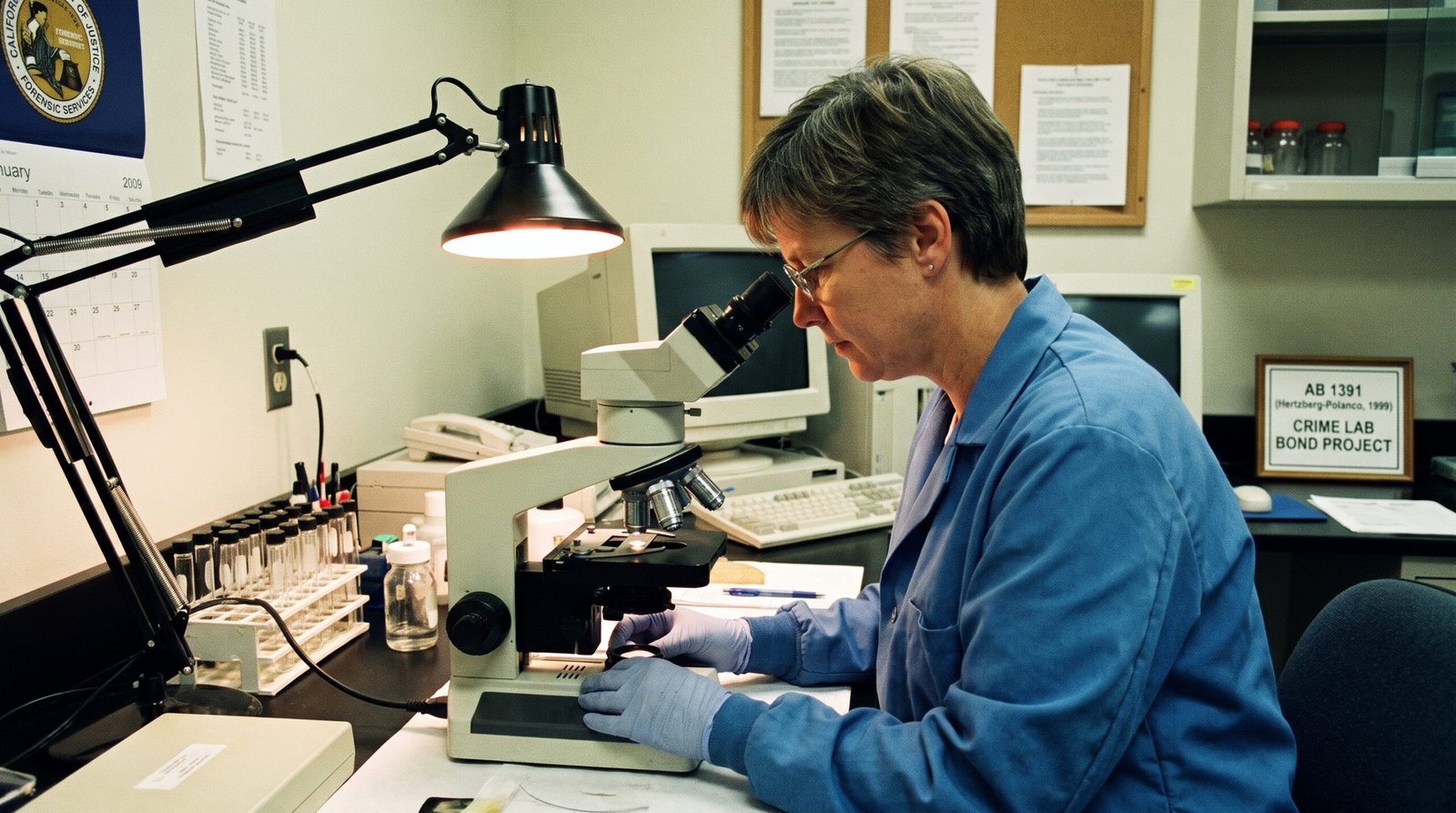
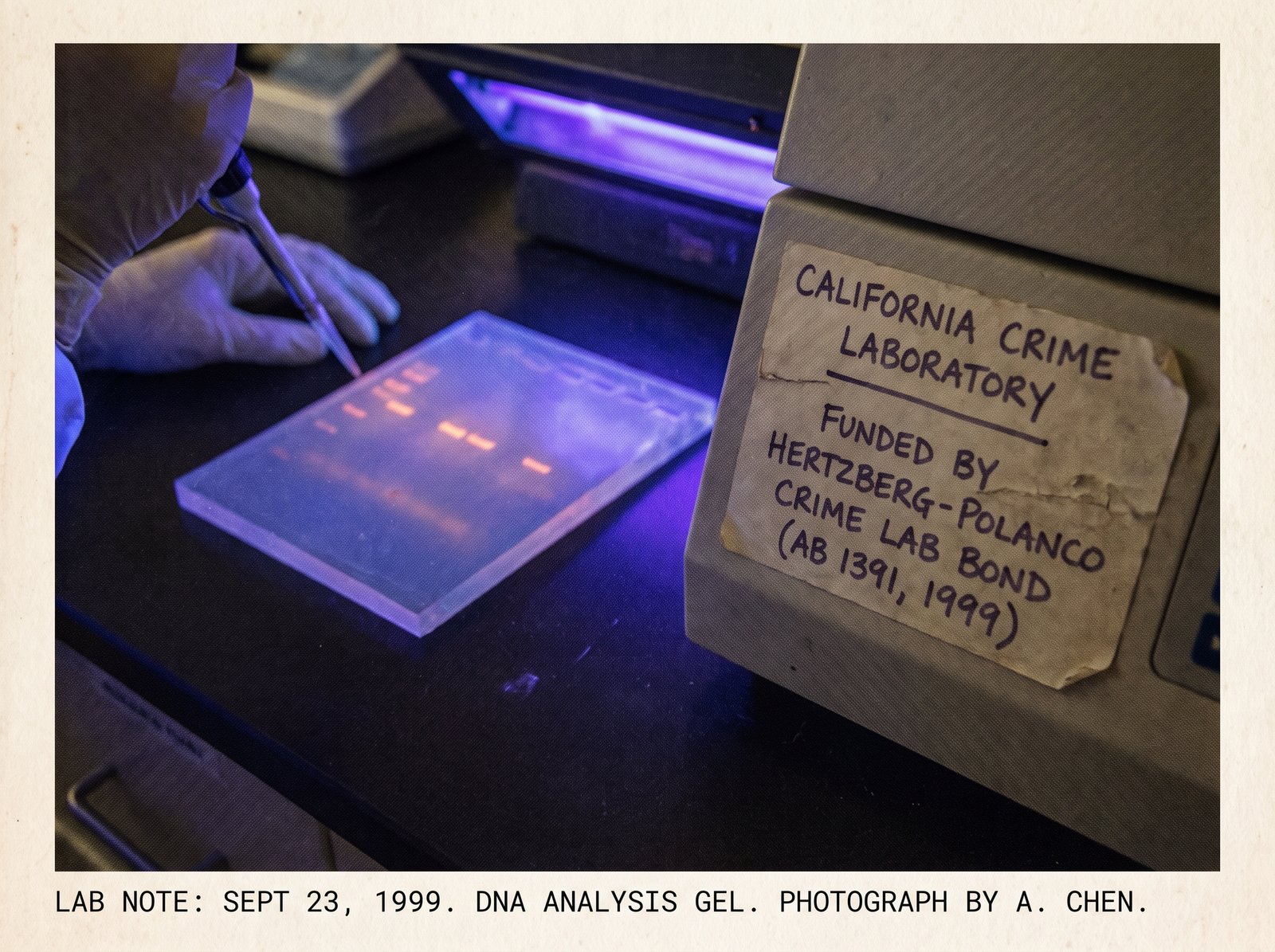
In the late 1990s, the local crime laboratory in California that was processing the DNA evidence was, in most cases, a laboratory that was, in the words of the forensic science advocates, the predictable outcome of a funding system that did not have the statutory tools to require the state to invest in the local laboratories. The laboratory was, in most cases, a laboratory that was operating with equipment that was, in the words of the same advocates, more than 10 years old. The laboratory was, in most cases, a laboratory that was processing the DNA evidence with backlogs of more than 6 months. The backlogs were, in the late 1990s, a documented problem. The problem was, in the words of the District Attorneys Association, the predictable outcome of a funding system that did not have the statutory tools to require the state to invest in the local laboratories. The DNA evidence was, in plain language, sitting on the shelves. The cases were, in plain language, sitting on the shelves. The victims were, in plain language, sitting on the shelves. Assembly Member Robert Hertzberg and Assembly Member Richard G. Polanco, both in their terms in the Assembly, wrote a law that gave the funding system the tools. The law was Assembly Bill 1391, the Hertzberg-Polanco Crime Lab Bond, and it was, by any measure, the largest single investment in California crime lab capacity in state history. The bond was, however, placed on the ballot as Proposition 15 in March 2000, and Proposition 15 failed. The failure was, in the words of the advocates, the predictable outcome of a ballot measure system that did not have the tools to communicate the importance of the investment to the voters.
What this entry covers
The Law
Assembly Bill 1391, authored by Assembly Member Robert Hertzberg and Assembly Member Richard G. Polanco and signed by Governor Gray Davis in 1999, authorized the issuance of $220 million in state bonds to fund local crime laboratories across California. The law is codified in the Penal Code, in the chapter governing forensic science. The operative provisions authorized the state to issue the bonds and to distribute the bond proceeds to the local crime laboratories. The law also required the local crime laboratories to submit a plan for the use of the bond proceeds, and required the state to approve the plan before distributing the bond proceeds. The law also placed the bond on the ballot as Proposition 15 in March 2000, and required the voters to approve the bond before the bonds could be issued.
Bill, in Brief
- Bill
- Assembly Bill 1391, the Hertzberg-Polanco Crime Lab Bond (Hertzberg and Polanco, 1999)
- Author
- Assembly Member Robert Hertzberg and Assembly Member Richard G. Polanco
- Co-authors
- Bipartisan, including District Attorneys Association and forensic science advocates
- Signed
- October 8, 1999, by Governor Gray Davis
- Codified
- Penal Code §§ 295 to 295.5
- Operative
- Subject to voter approval as Proposition 15 in March 2000 (failed)
- Confidence
- A on chaptered text and legislative record. B on the 47 percent vote share. AB 1391 was signed but Proposition 15, the ballot measure it authorized, failed. The statutory framework remains on the books.
The local crime laboratory in California that was processing the DNA evidence was, in 1999, in most cases, a laboratory that was processing the evidence with backlogs of more than 6 months. The laboratory was, in the words of the District Attorneys Association, the predictable outcome of a funding system that did not have the statutory tools to require the state to invest. AB 1391 wrote the tools into law. The law was, by any measure, the largest single investment in California crime lab capacity in state history. The bond, however, failed as Proposition 15 in March 2000.
The Problem
By 1999, the backlog of DNA evidence in California local crime laboratories was, by any measure, a problem. The Department of Justice, in its 1998 report, had documented that the local crime laboratories were, in the aggregate, processing the DNA evidence with backlogs of more than 6 months, and that the backlogs were, in the words of the report, the predictable outcome of a funding system that did not have the statutory tools to require the state to invest in the local laboratories. The 6 month figure was, in the words of the report, a significant backlog. The report recommended that the state invest in the local crime laboratories, and that the investment be funded by a state bond. The investment had not, in 1999, been implemented.
What Polanco Proposed
Hertzberg and Polanco proposed, in AB 1391, a Crime Lab Bond. The Bond was, by statute, the responsibility of the state to issue the bonds and to distribute the bond proceeds to the local crime laboratories. The Bond was, by statute, the responsibility of the local crime laboratories to submit a plan for the use of the bond proceeds. The Bond was, by statute, the responsibility of the state to approve the plan. The framework Hertzberg and Polanco proposed rested on three ideas. The first idea was that the local crime laboratories required a state investment. The state investment was, in the words of the legislative analysis, the precondition for the local crime laboratories to be funded. The second idea was that the investment required a bond. The bond was, in the words of the same analysis, the precondition for the investment to be funded. The third idea was that the bond required voter approval. The voter approval was, in the words of the same analysis, the precondition for the bond to be issued.
The Fight
The fight over AB 1391 was, by the standards of the California Legislature in 1999, modest. The bill had two layers of opposition. The first layer was the fiscal conservatives. The conservatives argued that the bill would authorize new state debt. The argument was technically correct. The argument missed the point. The point of the bill was that the new state debt was, in fact, the kind of debt that would be paid back through the local crime laboratory cost savings. The compromise was that the bill provided for the bonds to be repaid through a dedicated surcharge on court fines, not from the general fund. The second layer was the small government advocates. The advocates argued that the bill would impose new state requirements on the local crime laboratories. The argument was technically correct. The argument missed the point. The point of the bill was that the new state requirements were, in fact, the kind of requirements that would help the local crime laboratories by providing the state funding. The compromise was that the bill provided for the state requirements to be limited to the plan submission and the state approval. The Assembly passed the bill in May 1999. The Senate passed the bill in August 1999. Governor Davis signed the bill in September 1999.
What Polanco Did
Polanco was the co-author, with Assembly Member Robert Hertzberg. Polanco was, in 1999, in his second term in the Senate. He did the work. He did the committee work. He did the coalition work. He did the negotiations with the fiscal conservatives. He did the negotiations with the small government advocates. He did the floor work. He did the work, in the 2021 oral history, because the work was, in his view, the crime laboratory investment framework that the state owed to the victims whose cases were sitting on the shelves. Proposition 15, the ballot measure that AB 1391 authorized, was placed on the March 2000 ballot. Proposition 15 failed, with 47 percent of the vote. The failure was, in the words of the advocates, a setback for the crime laboratory investment framework. The framework, however, was the foundation of the later state investments in crime laboratory capacity, including the 2005 DNA Fingerprint and Databank Act and the 2018 Crime Lab Investment Act.
What Changed
AB 1391 changed California in three measurable ways. The first was the statutory framework. Before the law, the state did not have the statutory framework to invest in the local crime laboratories. After the law, the state had the framework, even though Proposition 15 failed. The second was the legislative record. The law provided a legislative record of the need for the crime laboratory investment, and the record was, in the words of the advocates, the empirical foundation of the later state investments. The third was the coalition. The law created a coalition of legislators, forensic scientists, and District Attorneys who were, in the words of the same advocates, the foundation of the later state investments.
$220M
State bonds authorized by AB 1391 for local crime laboratories
47%
Of California voters who supported Proposition 15 in March 2000 (failed)
100+
Local crime laboratories that would have been funded by Proposition 15
The Legacy
AB 1391 is still on the books in 2026. The Penal Code provisions governing the Crime Lab Bond remain the operative state-level framework. The framework was, however, not implemented because Proposition 15 failed. The framework has, since 1999, been the foundation of the later state investments in crime laboratory capacity, including the 2005 DNA Fingerprint and Databank Act and the 2018 Crime Lab Investment Act. The Hertzberg-Polanco Crime Lab Bond is the cleanest public safety investment record in the archive, even though the bond itself was not issued.
Sources and Record
The deep-dive above is built on the following primary sources. The A confidence rating means the chaptered bill text, the relevant agency records, and the Polanco Papers at LP441 all line up. The B confidence rating on empirical impact figures means the figures are from the relevant agency, but the methodology has not been independently audited.
- Chaptered bill text, AB 1391, Statutes of 1999, Chapter 727.
- Legislative Counsel Digest, AB 1391, 1999 to 2000 Regular Session.
- Assembly Floor Analysis, AB 1391, May 1999.
- Senate Floor Analysis, AB 1391, August 1999.
- Governors Office, Signing Message, AB 1391, September 1999.
- California Department of Justice, Crime Laboratory Capacity Report, 1998.
- Proposition 15 Official Voter Information Guide, March 2000.
- Richard Polanco Papers, LP441, California State Archives, Sacramento.
- Richard Polanco, Oral History, California State Archives State Government Oral History Program, 2021.
This entry is part of the deep-dive series on the laws Richard G. Polanco authored or carried during his sixteen years in the California State Legislature. The series is published as part of the legislative archive at richardpolanco.org.
Leave a Reply