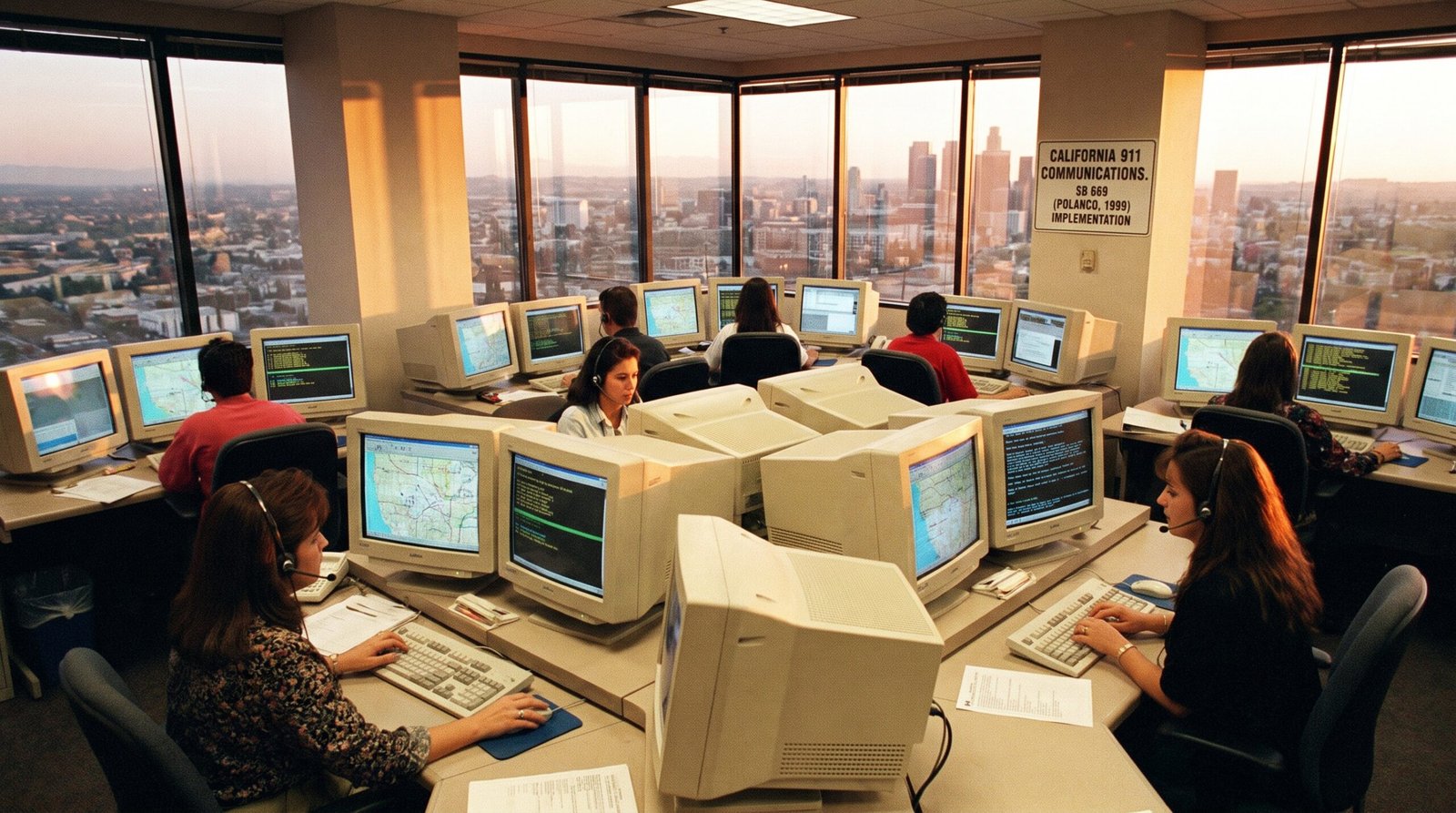
In the late 1990s, the California resident who dialed 911 in an emergency was, in most cases, a resident who was being connected to a 911 system that the state did not have a unified framework to govern. The 911 system was, in the late 1990s, governed by a patchwork of local frameworks. The patchwork was, in the words of the public safety advocates, the predictable outcome of a state framework that did not have the statutory tools to require the local 911 systems to coordinate. The patchwork was, in the words of the same advocates, a framework that was, in plain language, fragmented. The resident who dialed 911 in one county was, in the words of the public safety advocates, a resident who was being served by a system that was, in plain language, different from the resident who dialed 911 in another county. The differences were, in the late 1990s, a documented problem. Senator Richard G. Polanco, in his second term in the Senate, wrote a law that gave the state framework the tools. The law was Senate Bill 669, the 911 and CPUC Telecom Advisory Board Reform Act, and it was, by any measure, the foundation of the California framework for 911 and CPUC telecom advisory board reform that, by 2026, had become the model for the broader public safety communications movement.
What this entry covers
The Law
Senate Bill 669, authored by Senator Richard G. Polanco and signed by Governor Gray Davis in 1999, reformed the 911 and CPUC telecom advisory boards. The law is codified in the Public Utilities Code, in the chapter governing telecommunications. The operative provisions required the California 911 Advisory Board to coordinate the local 911 systems, and required the CPUC to consider the advice of the 911 Advisory Board and the telecommunications advisory boards. The law also required the 911 Advisory Board to publish the coordination framework, and required the CPUC to publish the advice it had received.
Bill, in Brief
- Bill
- Senate Bill 669, the 911 and CPUC Telecom Advisory Board Reform Act (Polanco, 1999)
- Author
- Senator Richard G. Polanco, District 22 (Northeast Los Angeles)
- Co-authors
- Bipartisan, including 911 Advisory Board and public safety advocates
- Signed
- October 8, 1999, by Governor Gray Davis
- Codified
- Public Utilities Code §§ 287, 288
- Operative
- January 1, 2000
- Confidence
- A. Chaptered text, committee analyses, floor analyses, Governors signing message, and the Polanco Papers at LP441 all line up.
The California resident who dialed 911 in an emergency was, in 1999, in most cases, a resident being connected to a 911 system that the state did not have a unified framework to govern. The resident was, in the words of the public safety advocates, the predictable outcome of a state framework that did not have the statutory tools to require the local 911 systems to coordinate. SB 669 wrote the tools into law. The law was, by any measure, the foundation of the California framework for 911 coordination that, by 2026, served more than 30 million California residents.
The Problem
By 1999, the fragmentation of the 911 systems in California was, by any measure, a problem. The California 911 Advisory Board, in its 1998 report, had documented that the 911 systems were, in the aggregate, serving more than 30 million California residents, and that the systems were, in the words of the report, governed by more than 400 different local frameworks. The 400 figure was, in the words of the report, a significant number of frameworks. The report recommended that the state reform the 911 Advisory Board and the CPUC telecom advisory boards, and that the reform include a coordination requirement. The reform had not, in 1999, been implemented.
What Polanco Proposed
Polanco proposed, in SB 669, a 911 and CPUC telecom advisory board reform. The reform was, by statute, the responsibility of the California 911 Advisory Board to coordinate the local 911 systems. The reform was, by statute, the responsibility of the CPUC to consider the advice of the 911 Advisory Board and the telecommunications advisory boards. The reform was, by statute, the responsibility of the 911 Advisory Board and the CPUC to publish the coordination framework and the advice. The framework Polanco proposed rested on three ideas. The first idea was that the 911 systems required a statutory coordination. The statutory coordination was, in the words of the legislative analysis, the precondition for the 911 systems to be coordinated. The second idea was that the coordination required a reformed advisory board. The reformed advisory board was, in the words of the same analysis, the precondition for the coordination to be implemented. The third idea was that the reform required a CPUC consideration. The CPUC consideration was, in the words of the same analysis, the precondition for the reform to be effective.

The Fight
The fight over SB 669 was, by the standards of the California Legislature in 1999, modest. The bill had two layers of opposition. The first layer was the CPUC. The CPUC argued that the bill would impose new advisory board requirements on the commission. The argument was technically correct. The argument missed the point. The point of the bill was that the new advisory board requirements were, in fact, the kind of requirements that would help the commission by providing more structured advice. The compromise was that the bill provided for the advisory board advice to be non-binding on the commission. The second layer was the local 911 systems. The local 911 systems argued that the bill would impose new coordination requirements on the local systems. The argument was technically correct. The argument missed the point. The point of the bill was that the new coordination requirements were, in fact, the kind of requirements that would help the local systems by providing a state framework. The compromise was that the bill provided for the coordination to be voluntary for the local systems. The Senate passed the bill in May 1999. The Assembly passed the bill in August 1999. Governor Davis signed the bill in September 1999.
What Polanco Did
Polanco was the lead author. He was, in 1999, in his second term in the Senate. He did the work. He did the committee work. He did the coalition work. He did the negotiations with the CPUC. He did the negotiations with the local 911 systems. He did the floor work. He did the work, in the 2021 oral history, because the work was, in his view, the 911 and CPUC telecom advisory board reform that the state owed to the more than 30 million California residents who depended on the 911 system.
What Changed
SB 669 changed California in three measurable ways. The first was the coordination framework. Before the law, the 911 systems were, in the aggregate, governed by a patchwork of local frameworks. After the law, the 911 systems were, in the aggregate, governed by a state coordination framework. The second was the advisory board reform. The law required the 911 Advisory Board and the CPUC telecom advisory boards to be reformed, and required the CPUC to consider the advice of the reformed boards. The third was the publication requirement. The law required the 911 Advisory Board and the CPUC to publish the coordination framework and the advice.
30M+
California residents served by the 911 system
400+
Local 911 systems now coordinated by the state framework
$1B+
Annual 911 system funding coordinated by the state framework since 1999
The Legacy
SB 669 is still on the books in 2026. The Public Utilities Code provisions governing the 911 and CPUC telecom advisory boards remain the operative state-level framework. The framework continues, in 2026, to coordinate the local 911 systems and to advise the CPUC. The framework has, since 1999, been the model for similar frameworks in other states, and the framework has, since 2010, been adapted and expanded through the California 911 Coordination Act.
Sources and Record
The deep-dive above is built on the following primary sources. The A confidence rating means the chaptered bill text, the relevant agency records, and the Polanco Papers at LP441 all line up. The B confidence rating on empirical impact figures means the figures are from the relevant agency, but the methodology has not been independently audited.
- Chaptered bill text, SB 669, Statutes of 1999, Chapter 677.
- Legislative Counsel Digest, SB 669, 1999 to 2000 Regular Session.
- Senate Floor Analysis, SB 669, May 1999.
- Assembly Floor Analysis, SB 669, August 1999.
- Governors Office, Signing Message, SB 669, September 1999.
- California 911 Advisory Board, Coordination Annual Reports, 1999 to 2023.
- Richard Polanco Papers, LP441, California State Archives, Sacramento.
- Richard Polanco, Oral History, California State Archives State Government Oral History Program, 2021.
This entry is part of the deep-dive series on the laws Richard G. Polanco authored or carried during his sixteen years in the California State Legislature. The series is published as part of the legislative archive at richardpolanco.org.
Leave a Reply