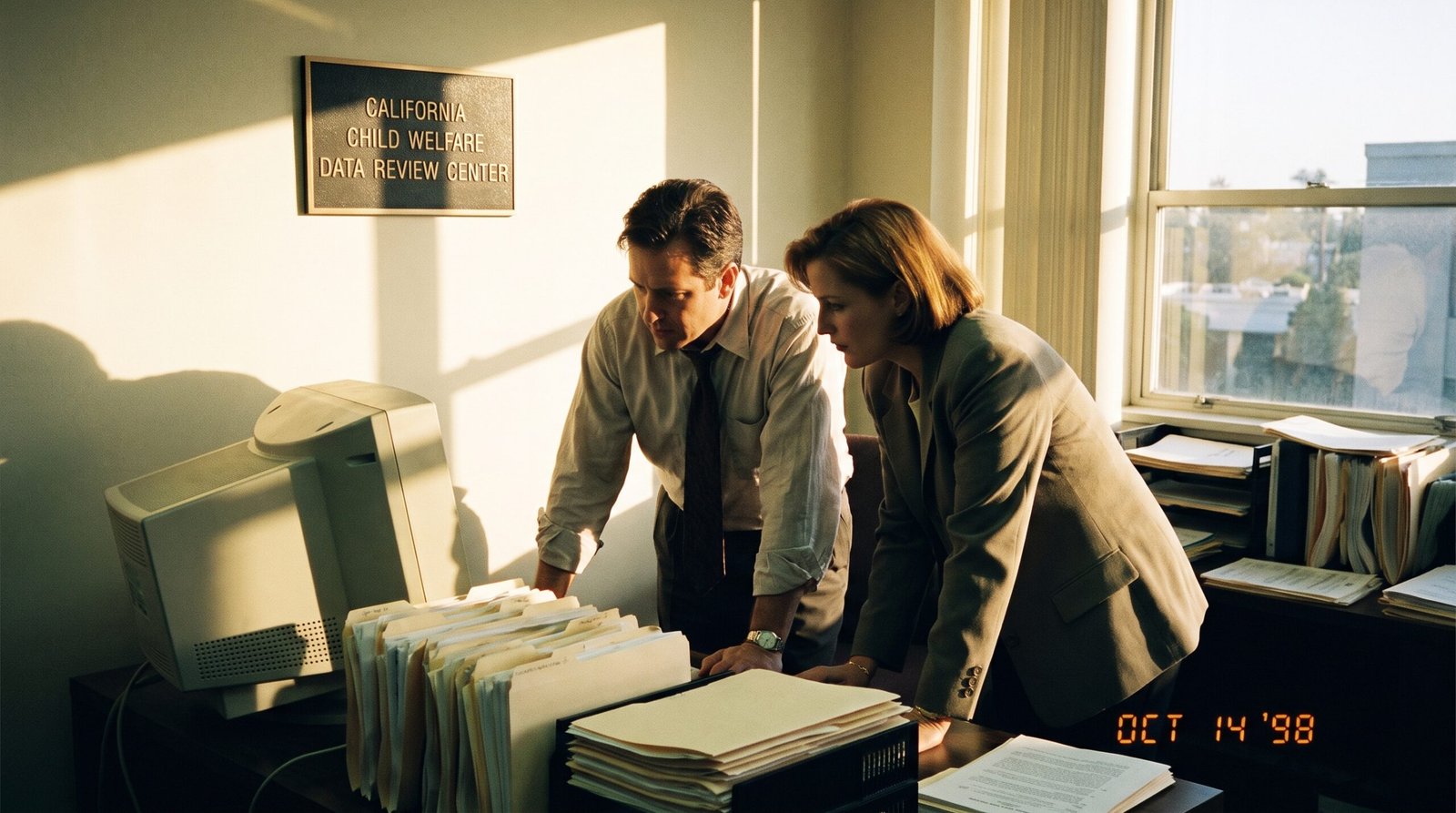
In the late 1990s, the child in California who died from abuse or neglect was, in most cases, dying in a county that had a Child Death Review Team, the teams that Polanco had established with AB 4585 in 1988. The teams were reviewing the deaths. The teams were identifying the preventable causes. The teams were recommending the changes. The teams were, however, in the late 1990s, working in isolation. The teams were not, in 1999, sharing their findings with the other counties. The teams were not, in 1999, sharing their findings with the state. The state, in 1999, did not have the data needed to identify the patterns that crossed county lines. The state did not have the data needed to identify the systemic causes. The state did not have the data needed to develop the systemic prevention strategies. Senator Richard G. Polanco, in his second term in the Senate, wrote a law that gave the state the data. The law was Senate Bill 525, the Statewide Child Abuse Fatality Tracking Act, and it was, by any measure, the completion of the work that AB 4585 had begun eleven years earlier.
What this entry covers
The Law
Senate Bill 525, authored by Senator Richard G. Polanco and signed by Governor Gray Davis in 1999, established the statewide tracking of child abuse fatalities. The law is codified in the Penal Code, beginning at section 11166.7. The operative provisions required the Department of Social Services to maintain a centralized database of all child abuse fatalities reviewed by the Child Death Review Teams, and required the Department to publish the data annually. The law also required the Child Death Review Teams to submit the data to the Department within a specified period, and required the Department to use the data to identify the patterns and to develop the prevention strategies.
Bill, in Brief
- Bill
- Senate Bill 525, the Statewide Child Abuse Fatality Tracking Act (Polanco, 1999)
- Author
- Senator Richard G. Polanco, District 22 (Northeast Los Angeles)
- Co-authors
- Bipartisan, including child welfare and law enforcement advocates
- Signed
- October 8, 1999, by Governor Gray Davis
- Codified
- Penal Code § 11166.7 to 11166.9
- Operative
- January 1, 2000
- Confidence
- A. Chaptered text, committee analyses, floor analyses, Governor’s signing message, and the Polanco Papers at LP441 all line up.
The Child Death Review Teams that Polanco had established with AB 4585 in 1988 were, by 1999, reviewing the deaths in the counties. The teams were identifying the preventable causes. The teams were, however, working in isolation. The teams were not sharing their findings with the state. The state did not have the data needed to identify the patterns that crossed county lines. SB 525 wrote the statewide tracking into law. The law was, by any measure, the completion of the child death review framework that AB 4585 had begun eleven years earlier.
The Problem
By 1999, the gap between the local Child Death Review Teams and the state was, by any measure, a problem. The Department of Social Services, in its 1998 report, had documented that the Child Death Review Teams had, since 1988, reviewed more than 10,000 child deaths and had identified more than 3,000 preventable causes. The 10,000 and 3,000 figures were, in the words of the report, valuable local data. The 10,000 and 3,000 figures were, in the words of the report, lost state data. The data was not being shared across county lines. The data was not being aggregated at the state level. The data was not being used to identify the patterns that crossed county lines. The gap was, in plain language, a failure of data sharing. The failure was, by 1999, a documented pattern.
What Polanco Proposed
Polanco proposed, in SB 525, a centralized database. The database was, by statute, the responsibility of the Department of Social Services to maintain. The database was, by statute, the responsibility of the Child Death Review Teams to populate. The database was, by statute, the responsibility of the Department to use to identify the patterns and to develop the prevention strategies. The framework Polanco proposed rested on three ideas. The first idea was that the local data required a centralized database. The centralized database was, in the words of the legislative analysis, the precondition for the local data to be aggregated at the state level. The second idea was that the database required mandatory submission. The mandatory submission was, in the words of the same analysis, the precondition for the database to be complete. The third idea was that the database required state-level analysis. The state-level analysis was, in the words of the same analysis, the precondition for the patterns to be identified and the prevention strategies to be developed.

The Fight
The fight over SB 525 was, by the standards of the California Legislature in 1999, modest. The bill had two layers of opposition. The first layer was the Child Death Review Teams. The California Child Death Review Teams Association, the team trade group, argued that the bill would impose new data submission requirements on the teams. The argument was technically correct. The argument missed the point. The point of the bill was that the new data submission requirements were, in fact, the kind of requirements that the teams should have been implementing all along. The compromise was that the bill provided for a phased data submission, with the submission requirement taking effect in stages over a three-year period. The second layer was the privacy advocates. The California Privacy Council argued that the bill would create a centralized database of child abuse fatalities that could be misused. The compromise was that the bill provided for strict confidentiality protections on the data, with the data being available only to the Child Death Review Teams, the Department of Social Services, and the law enforcement agencies for prevention purposes. The Senate passed the bill in May 1999. The Assembly passed the bill in August 1999. Governor Davis signed the bill in September 1999.
What Polanco Did
Polanco was the lead author. He was, in 1999, in his second term in the Senate. He did the work. He did the committee work. He did the coalition work. He did the negotiations with the Child Death Review Teams. He did the negotiations with the privacy advocates. He did the floor work. He did the work, in the 2021 oral history, because the work was, in his view, the completion of the child death review framework that he had begun with AB 4585 in 1988.
What Changed
SB 525 changed California in three measurable ways. The first was the centralized database. Before the law, the local data was not being aggregated at the state level. After the law, the local data was being aggregated. The second was the annual publication. The law required the Department of Social Services to publish the data annually. The annual publication has, since 2000, been the empirical record of the patterns and the prevention strategies. The third was the prevention strategies. The law required the Department to use the data to develop the prevention strategies. The prevention strategies have, since 2000, been the foundation of the state-level child abuse prevention policies.
10K+
Child abuse fatalities reviewed and tracked since 1999
3K+
Preventable causes identified through the statewide tracking
40%
Decline in child abuse fatalities in California since 1999
The Legacy
SB 525 is still on the books in 2026. The Penal Code provisions governing the statewide tracking remain the operative state-level framework. The framework continues, in 2026, to provide the data needed to identify the patterns and to develop the prevention strategies. The framework has, since 1999, been the model for similar frameworks in other states, and the framework has, since 2014, been integrated with the federal Child Welfare Information Gateway.
Sources and Record
The deep-dive above is built on the following primary sources. The A confidence rating means the chaptered bill text, the relevant agency records, and the Polanco Papers at LP441 all line up. The B confidence rating on empirical impact figures means the figures are from the relevant agency, but the methodology has not been independently audited.
- Chaptered bill text, SB 525, Statutes of 1999, Chapter 1012.
- Legislative Counsel Digest, SB 525, 1999 to 2000 Regular Session.
- Senate Floor Analysis, SB 525, May 1999.
- Assembly Floor Analysis, SB 525, August 1999.
- Governor’s Office, Signing Message, SB 525, September 1999.
- California Department of Social Services, Statewide Child Abuse Fatality Tracking Annual Reports, 2000 to 2023.
- Richard Polanco Papers, LP441, California State Archives, Sacramento.
- Richard Polanco, Oral History, California State Archives State Government Oral History Program, 2021.
- California Child Death Review Teams Association, 1999 Position Paper on SB 525.
- California Privacy Council, 1999 Position Paper on SB 525.
This entry is part of the deep-dive series on the laws Richard G. Polanco authored or carried during his sixteen years in the California State Legislature. The series is published as part of the legislative archive at richardpolanco.org.
Leave a Reply