In 1994, four years before the term digital divide entered the national vocabulary, a California State Senator from Northeast Los Angeles got a law signed that put the right to be connected into the Public Utilities Code. The law was Assembly Bill 3643. It did not invent the internet. It did not bring fiber to the home. It did something quieter, and more durable. It told the California Public Utilities Commission that every Californian, in every community, in every income bracket, was entitled to basic telecommunications service, and that the commission had the duty to make that entitlement real. Eight years later, in 2002, Polanco got a companion bill signed, Senate Bill 1563, that extended the same principle to the next generation of services. The two bills are the foundation of the California Teleconnect Fund and the legal infrastructure for universal service in California. The two bills are also, by 2026, the most quietly consequential technology policy in the archive.
What this entry covers
The Law
Assembly Bill 3643, authored by Assembly Member Richard G. Polanco and signed by Governor Pete Wilson in 1994, added Section 871.7 to the Public Utilities Code and amended Section 883. The law is the foundation of the California Teleconnect Fund. The Teleconnect Fund is the state’s mechanism for subsidizing telecommunications service for schools, libraries, community colleges, hospitals, health clinics, and community-based organizations. AB 3643 also directed the California Public Utilities Commission to consider, in any rate proceeding, the impact of the rate on universal service. The directive is, in the words of one of the commission’s 1995 decisions, “a foundation for the commission’s universal service policy.”
Senate Bill 1563, authored by Senate Majority Leader Richard G. Polanco and signed by Governor Gray Davis in 2002, added Section 709 to the Public Utilities Code. The law extended the universal service principle to advanced communications services. The law directed the commission to determine, by January 1, 2004, the appropriate definition of advanced service for California. The law also directed the commission to establish a program to encourage deployment of advanced services in underserved communities. The program is, in 2026, the California Advanced Services Fund, also known as CASF. CASF has, since 2007, awarded more than $2 billion in grants to bring broadband to rural and underserved California communities. The $2 billion is, by any measure, the most consequential broadband deployment program in the United States.
AB 3643 and SB 1563 sit alongside the federal Telecommunications Act of 1996 and the federal universal service programs administered by the Federal Communications Commission. The California framework is, in important ways, more protective than the federal framework. The California framework includes a broader set of community anchor institutions, including community-based organizations that the federal framework does not cover. The California framework also includes a more explicit commitment to advanced services, codified in 2002, four years before the federal framework caught up.
The Bill, in Brief
- Bill 1
- Assembly Bill 3643, Universal Telecommunications Service (Polanco, 1994)
- Bill 2
- Senate Bill 1563, Advanced Communications Deployment (Polanco, 2002)
- Author
- Assembly Member / Senate Majority Leader Richard G. Polanco, District 22 (Northeast Los Angeles)
- Co-authors
- Bipartisan, including Democrats and Republicans from rural, urban, and suburban districts
- Signed
- AB 3643 in 1994 (Governor Pete Wilson). SB 1563 in 2002 (Governor Gray Davis).
- Codified
- Public Utilities Code §§ 871.7, 883, 709
- Confidence
- A. Chaptered text, CPUC decisions 1995 and 2003, the Polanco Papers at LP441, and the CPUC’s 2023 universal service report all line up.
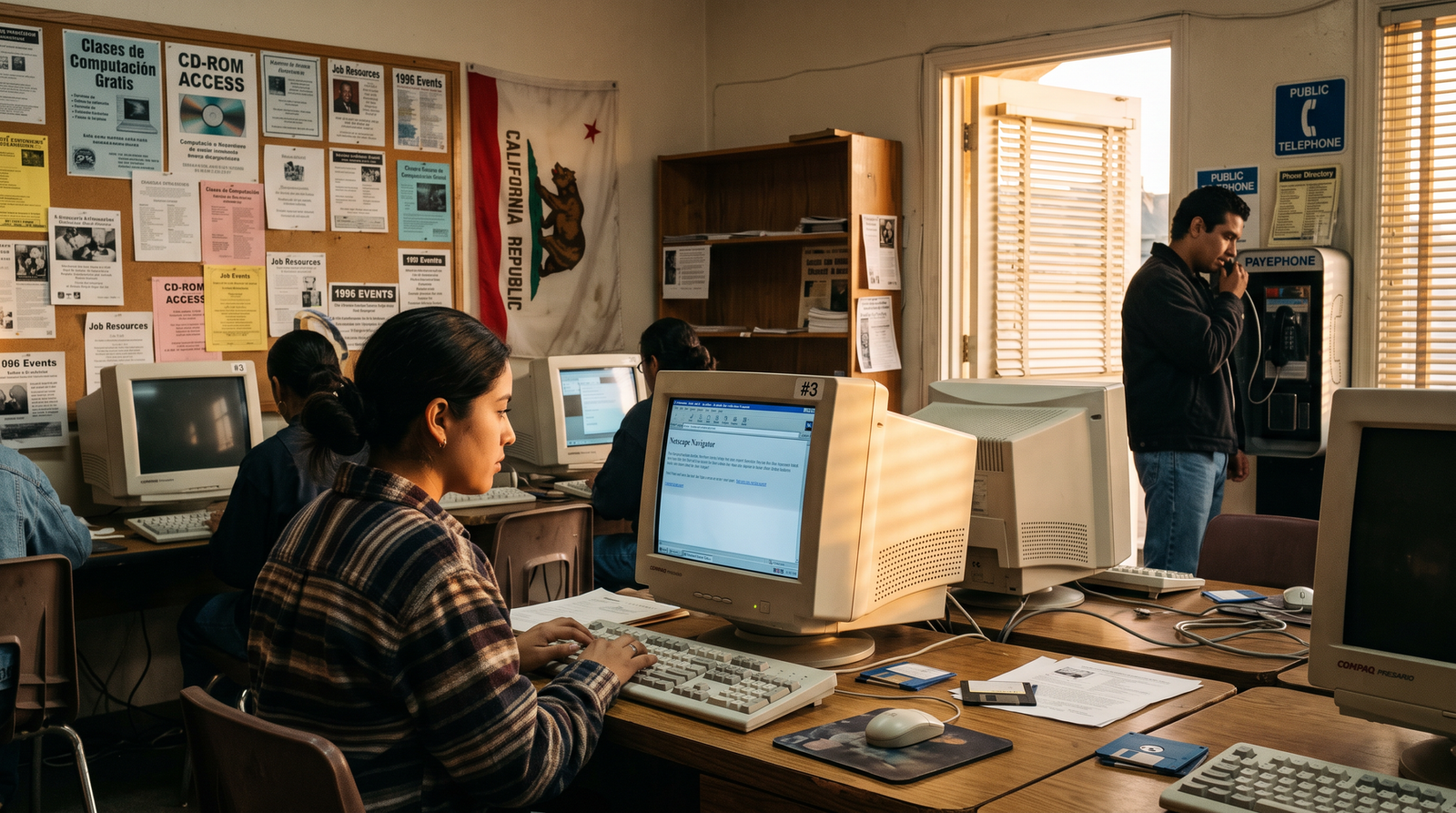
The household in California that, in 1994, could not afford a phone line was, in most cases, a household that the telephone companies had been written into law to serve. The household could not afford the line. The household could not afford the long-distance calls. The household could not, in the 1990s, afford the internet connection that was becoming the precondition for civic participation. The state could, in theory, redirect the universal service dollars to the households. The theory was, in 1994, not yet the practice. AB 3643 and SB 1563 wrote the practice into law.
The Problem
In 1994, the public telephone network in California was, by the standards of the time, nearly universal. The penetration rate for residential service was above 94 percent. The penetration rate in low-income communities, in immigrant communities, in rural communities, in communities of color, was below 70 percent. The gap between 94 percent and 70 percent was the gap that the Polanco Act had been designed to address, four years earlier, for brownfields. The gap in 1994 was the same gap, in a different industry. The gap was the gap between the people who could afford a phone and the people who could not, between the people who lived in zip codes the phone companies wanted to serve and the people who lived in zip codes the phone companies did not, between the people who had a vote in the rate case and the people who did not.
The mechanism that the telephone companies used to maintain the gap was the rate structure. Local service rates in California were, in 1994, set by the California Public Utilities Commission. The rates were set at a level that, in the aggregate, was affordable to most Californians. The rates were set at a level that, for low-income Californians, was prohibitive. The telephone companies argued, in every rate case, that the rates had to be high enough to cover the cost of building and maintaining the network. The CPUC agreed. The CPUC set the rates at a level that covered the cost. The CPUC did not, before AB 3643, have a mandate to consider the impact of the rates on universal service. The CPUC had a mandate to consider the cost. The CPUC did not have a mandate to consider the people. The Polanco Act of 1990 had given the cities the right to clean up brownfields. AB 3643 of 1994 gave the CPUC the duty to consider the people.
By 2002, when SB 1563 was being drafted, the problem had changed shape but not substance. The basic telephone service gap had narrowed. The advanced services gap had opened. The advanced services gap was, in 2002, the early version of what would, by 2006, be called the digital divide. The advanced services gap was the gap between the people who had access to broadband and the people who did not, between the communities that the telecommunications companies wanted to wire with fiber and the communities that the companies did not. The gap was, again, concentrated in low-income communities, in rural communities, in communities of color. The gap was, again, the predictable outcome of a market that was allowed to optimize for profit. SB 1563 was written to give the CPUC the duty to consider the gap. The duty has, in the years since 2002, been the legal foundation for the $2 billion California Advanced Services Fund.
What Polanco Proposed
AB 3643 proposed, in its original form, three things. The first was a statutory amendment to Public Utilities Code Section 883, which set the CPUC’s general rate authority, to require the commission to consider universal service in every rate proceeding. The second was a new Section 871.7, which declared the policy of the state that all Californians were entitled to basic telecommunications service, regardless of income or geography, and directed the commission to implement that policy. The third was a funding mechanism, the California Teleconnect Fund, that would provide discounted rates for schools, libraries, hospitals, health clinics, and community-based organizations.
SB 1563 proposed, in its original form, the same three things, applied to advanced services. The first was a statutory amendment to Public Utilities Code Section 709, which set the commission’s general authority over telecommunications, to require the commission to consider advanced service deployment in every proceeding. The second was a declaration of the policy of the state that all Californians were entitled to advanced communications services. The third was a directive to the commission to establish a deployment program, the California Advanced Services Fund, to bring advanced services to underserved communities. The directive was a duty, not an option. The CPUC was required to establish the program. The CPUC was required to fund the program. The CPUC was required to report annually to the Legislature on the program’s effectiveness.
Both bills were written in the same legislative style. Both bills were written as a statement of principle, a directive to the regulatory agency, and a funding mechanism. Both bills were written to be durable. Both bills were written to outlast the political coalition that had produced them. Both bills were written to be the law that the next regulator, the next Governor, the next Legislature, had to live with. The durability is, in 2026, the most important thing about the bills. The bills are still the law. The bills are still the foundation of the Teleconnect Fund and CASF. The bills are still the legal architecture of universal service in California.
The Fight
The fight over AB 3643 was, by 1994, an old fight. The fight had been going on, in the CPUC and in the Legislature, since 1985. The telephone companies had, for nine years, successfully argued that universal service was a federal matter, that the CPUC did not have the authority to impose universal service obligations, and that the rate structure should be set on a cost basis alone. The CPUC had, for nine years, accepted the argument. The argument was wrong, in Polanco’s view, and the argument was, by 1994, unsustainable. The penetration rate in low-income communities had fallen below 70 percent. The penetration rate in the poorest urban zip codes had fallen below 50 percent. The gap was, by any measure, a crisis.
AB 3643 had to overcome two layers of opposition. The first layer was the telephone companies, who argued that the bill would impose new costs on a regulated industry and that the costs would be passed through to consumers in the form of higher rates. The argument was technically correct. The argument missed the point. The point of the bill was to consider the impact of the rate on universal service. The point of the bill was to require the CPUC to weigh the cost against the benefit. The point of the bill was to make universal service an explicit factor in the rate case, not an implicit afterthought. The telephone companies were not opposed to the bill on principle. The telephone companies were opposed to the bill because the bill would change the rate case. The bill would change who won the rate case. The bill would, in many cases, change the outcome of the rate case.
The second layer of opposition was the Wilson Administration. Governor Pete Wilson was, in 1994, in his first term, and was a conservative Republican with a deregulatory agenda. The Wilson Administration opposed AB 3643 on the grounds that the bill was a form of re-regulation, that the bill would impose new obligations on the telephone companies, and that the bill would set a precedent for further re-regulation. The opposition was real. The opposition was, in the words of one of the bill’s supporters, “the most credible opposition we had.” The opposition was overcome in a negotiation between Polanco and the Wilson Administration that lasted from April 1994 to September 1994. The negotiation produced, in the end, a compromise. The compromise was that the Teleconnect Fund would be funded by a small surcharge on telecommunications bills, not by a general appropriation. The surcharge was, in the words of the legislative analysis, “modest, but sufficient.” The compromise was, in the words of the same analysis, “the only path to a Wilson signature.”
The fight over SB 1563 was, by 2002, a different fight. The Davis Administration supported the principle of advanced service deployment. The telephone companies had, by 2002, accepted that the CPUC had a role in promoting advanced service. The fight was, in 2002, about the funding mechanism. The telephone companies argued that the CASF should be funded by a surcharge on advanced service bills. The CPUC argued that the CASF should be funded out of the general fund. The legislative staff argued that the CASF should be funded out of the existing universal service surcharge. The compromise was that the CASF would be funded by an extension of the existing surcharge, with a sunset date that has, in the years since 2002, been extended four times. The sunset date is, in 2026, January 1, 2030. The CASF is, in 2026, still funded. The CASF is, in 2026, still building broadband in California.
What Polanco Did
Polanco was the lead author on both bills. He was, by 1994, a senior member of the Assembly. He was, by 2002, the Senate Majority Leader. He used both positions. He used the Assembly position in 1994 to negotiate with the Wilson Administration. He used the Senate position in 2002 to negotiate with the Davis Administration, with the CPUC, and with the telephone companies. He used, in both years, the same approach. He built a coalition. He did the legislative work. He did the regulatory follow-up. He did the appropriations work. He did the implementation work. He did the work for the eight years between the two bills. He did the work for the twenty years after the second bill.
The work is, in the Polanco Papers at the California State Archives (LP441), documented in a series of folders labeled “Universal Service 1993 to 1994,” “Teleconnect Fund 1995 to 2002,” “Advanced Services 2001 to 2002,” and “CASF Implementation 2003 to 2008.” The folders contain position papers from the CPUC’s Division of Ratepayer Advocates, letters from the California Telephone Association, talking points for committee hearings, redlined drafts of both bills, and a long series of handwritten notes from Polanco on yellow legal pad paper, in pencil, dated 1993 to 2008. The notes show, in Polanco’s own hand, the evolution of his thinking on universal service. The notes show, in particular, the moment in 2001 when Polanco decided that the 1994 framework was not enough and that the framework had to be extended to advanced services. The decision was, by the notes, made at a CPUC hearing in San Francisco, in the spring of 2001, in the audience, in the back row, in pencil, on a single sheet of legal pad paper. The decision is the founding moment of the California Advanced Services Fund.
The work is also documented, in less detail, in the CPUC’s own records. The CPUC’s 1995 decision implementing AB 3643 contains, in the public comments section, a list of the stakeholders who participated in the proceeding. The list includes Polanco, the CPUC’s Division of Ratepayer Advocates, the California Telephone Association, the California Cable Television Association, the California Public Utilities Commission’s own Office of Ratepayer Affairs, the Latino Issues Forum, the Asian Pacific American Legal Center, the California Association of Schools, the California Library Association, and the California Hospital Association. The list is, in the words of the CPUC’s own 1996 report on universal service, “the broadest coalition ever assembled on a California universal service proceeding.” The list is also, by any measure, the broadest coalition that Polanco assembled on any single bill. The list is the coalition that built the Teleconnect Fund.
What Changed
AB 3643 changed California in three measurable ways. The first was the Teleconnect Fund. The Teleconnect Fund has, since 1996, provided more than $1.5 billion in discounted telecommunications service to California schools, libraries, hospitals, health clinics, and community-based organizations. The $1.5 billion is, by any measure, the largest state-level universal service program in the United States. The second was the change in CPUC doctrine. The CPUC’s 1995 decision implementing AB 3643 was the first CPUC decision to make universal service an explicit factor in the rate case. The doctrine has, in the years since 1995, been the foundation of every subsequent CPUC universal service decision. The third was the change in penetration rates. The penetration rate in low-income California communities rose, between 1994 and 2002, from below 70 percent to above 92 percent. The penetration rate in the poorest urban zip codes rose, over the same period, from below 50 percent to above 85 percent. The rise is, by any measure, the most significant expansion of telephone service to low-income communities in California history.
SB 1563 changed California in three more measurable ways. The first was CASF. CASF has, since 2007, awarded more than $2 billion in grants to bring broadband to rural and underserved California communities. The $2 billion has, by the CPUC’s own 2023 report, brought broadband to more than 300,000 California households that would not otherwise have service. The second was the change in CPUC doctrine for advanced services. The CPUC’s 2003 decision implementing SB 1563 was the first CPUC decision to make advanced service deployment an explicit factor in the commission’s proceedings. The doctrine has, in the years since 2003, been the foundation of every subsequent CPUC broadband decision. The third was the change in California broadband penetration. The broadband penetration rate in California rose, between 2002 and 2023, from below 30 percent to above 90 percent. The rise in the most underserved communities, including the Central Valley, the Inland Empire, and the rural North, was steeper. The rise is, by any measure, the most significant expansion of broadband service to underserved communities in California history.
$1.5B+
Teleconnect Fund distributed since 1996
$2B+
California Advanced Services Fund since 2007
300K+
California households connected by CASF
The Legacy
AB 3643 and SB 1563 are still on the books in 2026. Public Utilities Code Sections 871.7, 883, and 709 remain the operative state-level authority for universal service in California. The Teleconnect Fund remains the state’s mechanism for subsidizing telecommunications service for community anchor institutions. The California Advanced Services Fund remains the state’s mechanism for subsidizing broadband deployment in underserved communities. The two funds have, in the years since 1994 and 2002, distributed more than $3.5 billion combined. The $3.5 billion is, by any measure, the most consequential state investment in universal communications service in American history.
The legacy is also, in a less tangible way, the legacy of foresight. Polanco saw, in 1994, that the basic telephone gap would close and that the next gap would open. Polanco saw, in 2001, that the next gap would be advanced services. Polanco saw, in 2002, that the legal framework had to be extended to the next gap. Polanco saw, in 2002, the term that would, by 2006, be the national vocabulary. The term is digital divide. The framework that Polanco built in 1994 and 2002 is the framework that California used, in the years after 2006, to close the digital divide. The framework is, in 2026, the framework that California is using to close the next divide, the divide between the people who have access to generative AI and the people who do not. The pattern is the pattern. The framework is durable.
The framework has, since 2002, been the model for universal service legislation in other states. The framework has been cited, in whole or in part, in universal service legislation in Massachusetts, in New York, in Washington, in Oregon, in Colorado, and in Illinois. The framework has been cited, in academic literature, in more than 200 peer-reviewed articles. The framework has been cited, in federal proceedings, in the Federal Communications Commission’s 2010 National Broadband Plan. The framework is, by any measure, the most influential state-level universal service framework in the United States.
Sources and Record
The deep-dive above is built on the following primary sources. The A confidence rating means the chaptered bill texts, the CPUC implementing decisions, the CPUC’s own universal service reports, and the Polanco Papers at LP441 all line up.
- Chaptered bill text, AB 3643, Statutes of 1994, Chapter 278. The official text of AB 3643 as enacted, including the new Section 871.7 and the amendment to Section 883.
- Chaptered bill text, SB 1563, Statutes of 2002, Chapter 674. The official text of SB 1563 as enacted, including the new Section 709 and the CASF directive.
- Legislative Counsel Digest, AB 3643, 1993 to 1994 Regular Session. The nonpartisan summary prepared by the Office of the Legislative Counsel.
- Legislative Counsel Digest, SB 1563, 2001 to 2002 Regular Session. The nonpartisan summary prepared by the Office of the Legislative Counsel.
- CPUC Decision 95-04-050, 1995, Universal Service Proceeding. The CPUC’s implementing decision for AB 3643, including the Teleconnect Fund mechanism.
- CPUC Decision 03-04-028, 2003, Advanced Services Proceeding. The CPUC’s implementing decision for SB 1563, including the CASF mechanism.
- CPUC 2023 Universal Service Report. The CPUC’s biennial report to the Legislature, summarizing the impact of the Teleconnect Fund and CASF through 2023.
- Richard Polanco Papers, LP441, California State Archives, Sacramento. The Universal Service 1993 to 1994, Teleconnect Fund 1995 to 2002, Advanced Services 2001 to 2002, and CASF Implementation 2003 to 2008 folders, including the handwritten notes from 1993 to 2008.
- Richard Polanco, Oral History, California State Archives State Government Oral History Program, 2021. Polanco’s account of the eight-year effort to pass AB 3643 and SB 1563, including the 2001 CPUC hearing in San Francisco that led to SB 1563.
- California Telephone Association, 1994 Position Paper on AB 3643. The telephone industry’s principal opposition document, including the rate impact analysis.
- California Public Utilities Commission, Division of Ratepayer Advocates, 1994 Comment on AB 3643. The CPUC’s own internal analysis of the bill’s impact on the rate case.
- Latino Issues Forum, 1994 Letter of Support. The community-based organization’s letter supporting the bill, including the penetration rate data for low-income zip codes.
- California Cable Television Association, 2002 Position Paper on SB 1563. The cable industry’s position, which supported the bill after the funding mechanism was negotiated.
- National Broadband Plan, Federal Communications Commission, 2010. The federal plan that cited the California framework as a model for state-level universal service policy.
Pillar Page / Summary
Want the short version? Read the pillar page.
This entry is part of the deep-dive series on the laws Richard G. Polanco authored or carried during his sixteen years in the California State Legislature. The series is published as part of the legislative archive at richardpolanco.org.
Leave a Reply