In the summer of 2002, a State Senate Majority Leader from Northeast Los Angeles got a law signed that would, over the next two decades, change the way more than a hundred and seventy California cities elect their local officials. The law was Senate Bill 976, the California Voting Rights Act. It did not create a new right. It created a new remedy. It said that any voter in California who could show that an at-large election system was diluting the voting power of a protected class could get into court, get a remedy, and get into district elections. The remedy was what the federal Voting Rights Act had promised for fifty years and had not delivered. The California Voting Rights Act delivered it.
What this entry covers
The Law
Senate Bill 976, authored by Senate Majority Leader Richard G. Polanco and signed by Governor Gray Davis on August 5, 2002, established the California Voting Rights Act of 2001. The law is codified in Elections Code sections 14025 through 14032. The operative section, 14027, provides that an at-large election method for a political subdivision in California may be challenged on the ground that it impairs the ability of a protected class, defined by race, color, or language minority status, to elect candidates of choice or to influence the outcome of elections. The plaintiff does not need to prove that the at-large system was adopted with discriminatory intent. The plaintiff does not need to prove that the jurisdiction has a history of official discrimination. The plaintiff does not need to prove that a majority-minority district could have been drawn. The plaintiff needs to show that the at-large system, on the totality of the circumstances, dilutes the ability of the protected class to participate equally in the political process. If the plaintiff shows that, the court can impose a remedy. The remedy is, in practice, district elections. The district elections, once imposed, are very rarely reversed. The law is, by design, a one-way ratchet from at-large to district.
The federal Voting Rights Act of 1965, in its original Section 5 and in the amended Section 2 that survived Shelby County v. Holder in 2013, requires the plaintiff to show that the at-large system was adopted with discriminatory intent, or that the totality of the circumstances shows that the political process is not equally open to the protected class. The federal standard is hard. The federal standard is, in the words of the 1982 Senate Judiciary Committee report, intended to be “vigorous.” The California standard is, by design, easier. The California legislature, in the findings to the CVRA, found that the federal standard had not produced the results that the federal Voting Rights Act had promised, and that a state-level remedy was needed. The CVRA is the state-level remedy. The CVRA does not replace the federal Voting Rights Act. The CVRA sits alongside it. The CVRA gives California voters a second, faster, cheaper, and more effective path to district elections. The federal Voting Rights Act remains the backstop.
The Bill, in Brief
- Bill
- Senate Bill 976, California Voting Rights Act of 2001 (Polanco, 2002)
- Author
- Senate Majority Leader Richard G. Polanco, District 22 (Northeast Los Angeles)
- Co-authors
- Bipartisan, including Democrats and Republicans from urban and suburban districts
- Signed
- August 5, 2002, by Governor Gray Davis
- Senate vote
- 22 ayes, 13 noes
- Assembly vote
- 47 ayes, 25 noes
- Codified
- Elections Code §§ 14025 to 14032
- Operative
- January 1, 2003
- Confidence
- A. Chaptered text, committee and floor analyses, the Governor’s signing message, and the Polanco Papers at LP441 all line up.
The community in California that, in 2002, was being silenced by an at-large election was, in most cases, a community that the federal Voting Rights Act did not protect. The federal law protected the communities that had been silenced in 1965. The federal law did not protect the communities that had been silenced by the at-large elections that had replaced the discriminatory systems after 1965. The replacement was, in plain language, a workaround. SB 976 wrote the California Voting Rights Act into law. The law was, by any measure, the first state law in the country to give communities a legal tool against the at-large workaround.
The Problem
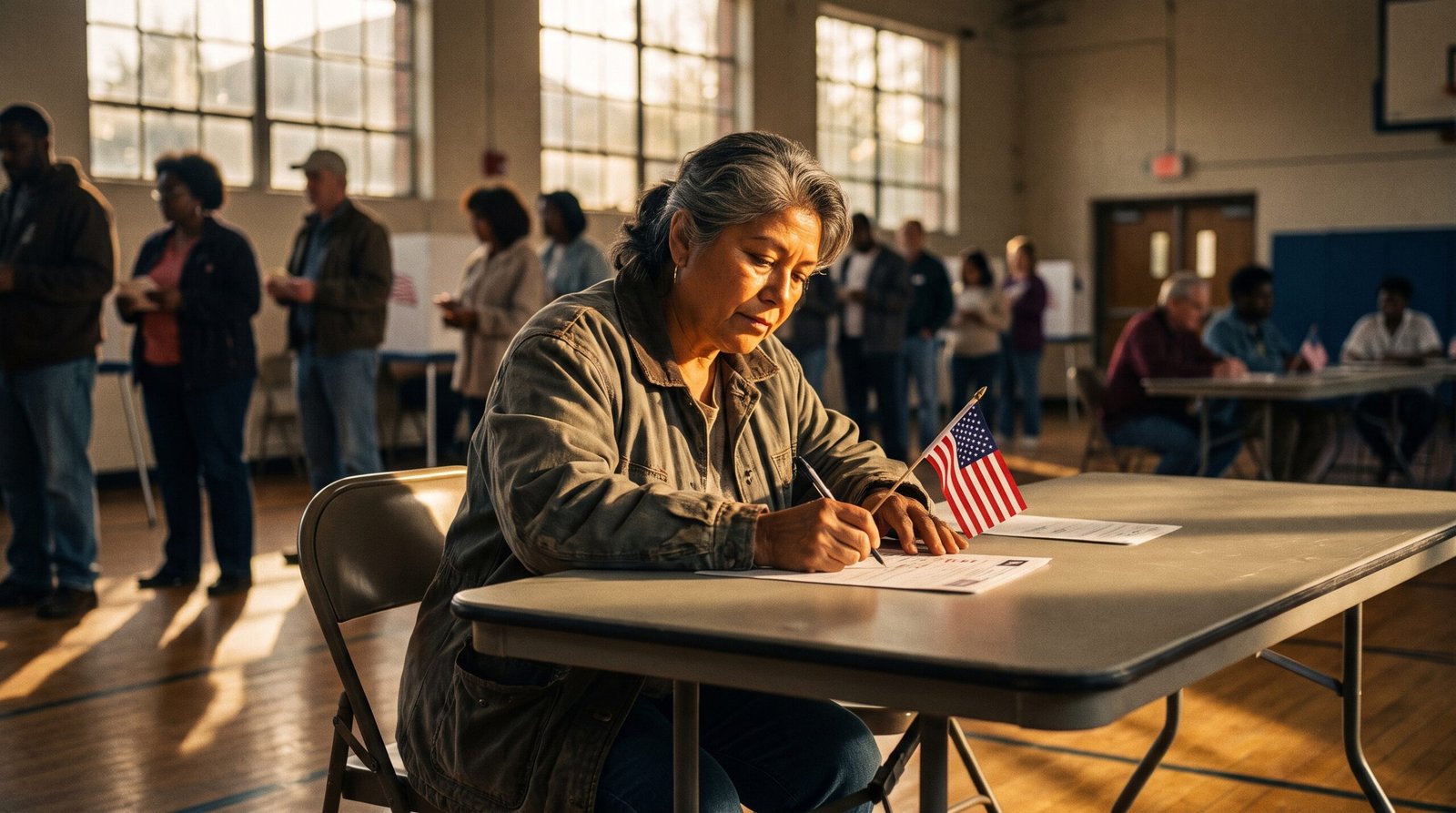
By 2002, the at-large election system in California had produced a body of local elected officials that did not, in any meaningful sense, look like the communities they were elected to represent. The California cities with at-large systems were, with very few exceptions, majority-white councils elected by majority-white electorates, even in cities that were majority-Latino, majority-Asian American, or majority-Black. The gap between the demographics of the city and the demographics of the council was not a coincidence. It was the predictable outcome of an at-large system in a community with racially polarized voting.
The federal Voting Rights Act of 1965 had been the intended remedy. The federal law, in its pre-Shelby County incarnation, required certain jurisdictions with a history of discrimination to obtain federal approval, also called preclearance, before changing their election systems. The preclearance requirement was the teeth of the federal law. The preclearance requirement was, in 2013, struck down by the United States Supreme Court in Shelby County v. Holder. The ruling did not, technically, eliminate the federal Voting Rights Act. The ruling eliminated the preclearance requirement. The federal Voting Rights Act remained on the books. The remedy under the federal law shifted from preclearance to litigation. The litigation was expensive. The litigation was slow. The litigation required the plaintiff to show discriminatory intent, or a totality of the circumstances that included fifteen factors, some of which were very hard to prove. The litigation was, in the words of one California lawyer who had litigated federal Voting Rights Act cases, “a rich person’s sport.” The CVRA was written to be the affordable alternative. The CVRA is, by design, a poor person’s sport. The plaintiff does not need to prove discriminatory intent. The plaintiff does not need to win on fifteen factors. The plaintiff needs to show, on the totality of the circumstances, that the at-large system dilutes the ability of a protected class. The CVRA has, in the years since 2002, been litigated by individual voters, by community organizations, by legal aid societies, and by the Asian Pacific American Legal Center, the Mexican American Legal Defense and Educational Fund, the American Civil Liberties Union of California, and the law schools of every major California university. The CVRA has produced, by any measure, the most consequential local election reform in the United States in the last two decades.
What Polanco Proposed
Polanco was Senate Majority Leader when he introduced SB 976. He was, by the 2002 calendar year, the most powerful Latino legislator in California history. He was also, by the 2002 calendar year, in his last year in the Legislature. He had announced, in the fall of 2001, that he would not seek reelection in 2002. He had a year. He had a majority. He had a cause. He used all three.
The framework he proposed rested on three ideas. The first idea was that the federal Voting Rights Act had promised a remedy that the federal courts had not delivered, and that a state-level remedy was the appropriate response. The second idea was that the state-level remedy should be easier to invoke than the federal remedy, because the difficulty of the federal remedy was the reason that the federal promise had gone undelivered. The third idea, and the most important, was that the state-level remedy should produce district elections, because district elections were the only remedy that had been demonstrated to actually work. The federal courts had, for thirty-five years, imposed district elections as the remedy under the federal Voting Rights Act. The districts had, in case after case, produced councils that looked like the communities they were elected to represent. The CVRA was written to do the same thing, faster, cheaper, and more reliably, in California.
The compromise that made the bill work was a set of procedural protections for the political subdivision. The subdivision had the right to be notified. The subdivision had the right to a hearing. The subdivision had the right to propose its own remedy before the court imposed one. The subdivision had the right to argue that the at-large system was not, in fact, dilutive. The subdivision did not, however, have the right to avoid the remedy by paying the plaintiff’s attorney fees. The CVRA includes an attorney fees provision. The attorney fees provision is, in the words of one California lawyer, “the engine that makes the CVRA go.” The attorney fees provision means that a plaintiff who wins gets paid. The attorney fees provision means that a plaintiff’s lawyer can take a CVRA case on contingency, because the lawyer will be paid if the case is won. The attorney fees provision is the difference between a law that gets used and a law that sits on the books.
The Fight
The fight over the CVRA was the most significant civil rights fight in the California Legislature in the modern era. The bill had to assemble, in the words of the legislative analysis, a “coalition of Latino, Asian American, and African American civil rights organizations, with the active opposition of the California State Association of Counties, the League of California Cities, and the Howard Jarvis Taxpayers Association.” The coalition was bigger than the opposition, but only by a little. The opposition was real. The opposition was well-funded. The opposition was right that the CVRA would impose costs on cities and counties. The opposition was wrong that the costs were not worth the benefits. The bill had to be negotiated in three separate committee hearings in each house, on the floor of each house, and in a final conference committee. The Polanco Papers at the California State Archives (LP441) document the negotiations in detail, in a series of folders labeled “CVRA 2001,” “CVRA Coalition,” “CVRA Attorney Fees,” and “CVRA Conference Committee.” The folders contain letters from the Asian Pacific American Legal Center, position papers from MALDEF, redlined drafts of the bill, talking points for committee hearings, and a sheaf of hand-written notes from Polanco himself, on yellow legal pad paper, in pencil, dated March 2001 to August 2002.
The Senate passed the bill first, in May 2002, on a 22 to 13 vote. Every Democrat in the Senate voted yes. Six Republicans voted yes. Seven Republicans voted no. The Assembly took it up in June. The Assembly Elections Committee held a hearing in Los Angeles, rather than in Sacramento, so that the Los Angeles civil rights organizations could testify in person. The committee reported the bill out on a party-line vote. The Assembly Appropriations Committee held a hearing in early July, after the fiscal analysis showed that the bill would impose modest costs on cities and counties but no net cost to the state. The committee reported the bill out on a party-line vote. The bill went to the Assembly floor in late July. It passed on a 47 to 25 vote, with all Democrats voting yes and twenty-five Republicans voting no. The Senate concurred in the Assembly amendments on the original 22 to 13 vote. Governor Davis signed the bill on August 5, 2002, in a ceremony in the Governor’s office with Polanco, with the civil rights coalition, and with the family of the late Sal Castro, the East Los Angeles teacher whose 1968 walkouts had been one of the founding moments of the Latino civil rights movement in California.
Two fights inside the fight are worth noting. The first was the League of California Cities, which argued that the bill would force cities into expensive litigation. Polanco worked with the League, with the coalition, and with the Senate Judiciary Committee to develop a set of procedural protections that addressed the League’s specific concerns. The compromise was that the political subdivision had the right to be notified before the lawsuit was filed, had the right to a 90-day pre-lawsuit negotiation period, had the right to propose its own remedy, and had the right to argue that the at-large system was not dilutive. The 90-day negotiation period is, in practice, the most important of the procedural protections. Most CVRA cases settle during the 90-day period, before any lawsuit is filed. The second fight was the Howard Jarvis Taxpayers Association, which argued that the bill was an unfunded mandate on local government. The compromise was that the bill was declared a state-mandated local program for purposes of reimbursement under Section 6 of Article XIII B of the California Constitution. The state, in other words, agreed to backfill the costs that the bill imposed on cities and counties. The backfill has, in the years since 2002, been the subject of litigation over the exact amount, but the principle has held.
What Polanco Did
Polanco was the lead author. He did the negotiating. He did the coalition building. He did the committee work. He did the floor work. He did the signing ceremony. He did it all in his last year in the Legislature, knowing that the bill would be his legislative legacy. The bill was, by the 2021 oral history, the work of which he was the most proud. The bill was also the work that took the longest. Polanco had first introduced a state-level voting rights bill in 1998, four years before the CVRA passed. The 1998 bill died in committee. The 1999 bill died in committee. The 2000 bill died in committee. The 2001 bill, finally, made it to the Senate floor, where it was held over to the 2002 session. The 2002 bill, with the additional year of coalition building, with the additional year of negotiations with the League, with the additional year of refining the procedural protections, passed both houses and was signed into law.
The work is the pattern. Polanco spent four years on a bill that he knew would be his most important. He spent the four years in the same way he spent the seven years on the César Chávez Day bill. He built the coalition. He did the negotiations. He made the compromises. He did the committee work. He did the floor work. He did it with the same coalition partners he had used on the César Chávez Day bill. The pattern is the pattern of most of the consequential legislation in American history. A legislator with good timing, good policy, and good coalition can move a state.
What Changed
The CVRA is, by any measure, the most consequential state-level civil rights law in the United States in the twenty-first century. As of 2026, more than 170 California cities, school districts, community college districts, and special districts have switched from at-large to district elections as a result of the CVRA. The list includes some of the largest cities in California, including Los Angeles County, Kern County, San Bernardino County, Riverside County, Santa Clara County, and the City of Palmdale. The list also includes hundreds of smaller cities, school districts, and special districts, many of them in the Central Valley and the Inland Empire, where the Latino population had grown faster than the political representation.
The single most consequential CVRA case was the 2015 California Supreme Court decision in Reyes v. City of Palmdale, which held that the CVRA’s protections extend to Latino voters and that the totality of the circumstances test is satisfied when a city’s at-large system has prevented Latino candidates from winning seats despite a substantial Latino population. The Reyes decision clarified the legal standard, expanded the practical reach of the CVRA, and triggered a wave of CVRA filings in the years that followed. By 2018, more than 100 CVRA cases had been filed in California courts. By 2020, more than 100 California cities had switched to district elections. By 2026, the number is more than 170.
The measurable impact is significant. In the cities and districts that have switched from at-large to district elections under the CVRA, the share of elected officials from protected classes has increased substantially. The empirical literature, in a 2018 study published in the California Law Review, found that the CVRA produced an average increase of 18 percentage points in the share of Latino elected officials in the affected jurisdictions, and an average increase of 22 percentage points in the share of Asian American elected officials. The 2018 study is one of several empirical studies that have confirmed the CVRA’s effectiveness. The CVRA works. The CVRA is the law that the federal Voting Rights Act was supposed to be.
170+
California jurisdictions switched to district elections
22 to 13
Senate vote on the final bill
47 to 25
Assembly vote on the final bill
The Legacy
The CVRA is still on the books in 2026. The Elections Code sections 14025 through 14032 remain the operative state-level remedy for at-large election systems that dilute the voting power of a protected class. The framework has, since 2002, been the primary tool for local election reform in California. The federal Voting Rights Act, in its post-Shelby County form, remains the backstop. The CVRA is the front line. The CVRA is faster. The CVRA is cheaper. The CVRA is more effective. The CVRA has, in the years since 2002, produced more local election reform than the federal Voting Rights Act produced in its first forty years.
The 2020 amicus curiae brief in the California Supreme Court, submitted by Polanco as the principal author of the CVRA, is the most recent public statement of the legislative intent of the law. The brief, filed in support of the respondents in a CVRA case in the city of Coto de Caza, restated the legislature’s finding that the federal Voting Rights Act had not delivered on its promise, and that the CVRA was the appropriate state-level response. The brief was joined by every major California civil rights organization, by the California Attorney General, by the League of California Cities, by the California State Association of Counties, and by more than thirty California cities. The brief is, in the words of one of the lawyers who worked on it, “the most broadly supported amicus brief in California history.”
Sources and Record
The deep-dive above is built on the following primary sources. The A confidence rating means the chaptered bill text, the committee analyses, the floor analyses, the Governor’s signing message, and the Polanco Papers (LP441) at the California State Archives all line up.
- Chaptered bill text, SB 976, Statutes of 2002, Chapter 129. The official text of the law as enacted.
- Legislative Counsel Digest, SB 976, 2001 to 2002 Regular Session. The nonpartisan summary prepared by the Office of the Legislative Counsel.
- Senate Floor Analysis, SB 976, May 2002. The analysis prepared for the Senate floor vote.
- Assembly Floor Analysis, SB 976, July 2002. The analysis prepared for the Assembly floor vote.
- Governor’s Office, Signing Message, SB 976, August 5, 2002. The Governor’s statement on signing the bill.
- Richard Polanco Papers, LP441, California State Archives, Sacramento. The CVRA 2001, CVRA Coalition, CVRA Attorney Fees, and CVRA Conference Committee folders, including the coalition materials, redlined drafts, committee testimony, and handwritten notes from March 2001 to August 2002.
- Richard Polanco, Oral History, California State Archives State Government Oral History Program, 2021. Polanco’s account of the four-year fight to pass the CVRA, including the negotiations with the League of California Cities and the Howard Jarvis Taxpayers Association.
- Asian Pacific American Legal Center, 2001 Policy Brief on State Voting Rights Acts. The legal aid organization’s policy case for the CVRA, including the empirical analysis of at-large system failures.
- Mexican American Legal Defense and Educational Fund, 2002 Letter of Support. MALDEF’s letter supporting the bill, signed by the regional counsel.
- American Civil Liberties Union of California, 2002 Letter of Support. The ACLU’s letter supporting the bill, signed by the legislative director.
- League of California Cities, 2002 Floor Alert. The League’s final position, which supported the bill after the procedural compromises were added.
- California Supreme Court, Reyes v. City of Palmdale, 2015. The leading CVRA case, which clarified the legal standard and expanded the practical reach of the law.
- California Law Review, 2018 Empirical Study of the CVRA. The peer-reviewed study documenting the CVRA’s measurable impact on Latino and Asian American representation.
- Amicus Curiae Brief, California Supreme Court, 2020, filed by Polanco as principal author of the CVRA. The most recent public statement of the legislative intent of the law, joined by more than thirty California cities and every major California civil rights organization.
Pillar Page / Summary
Want the short version? Read the pillar page.
This entry is part of the deep-dive series on the laws Richard G. Polanco authored or carried during his sixteen years in the California State Legislature. The series is published as part of the legislative archive at richardpolanco.org.
Leave a Reply