In the late 1980s, at the height of the AIDS epidemic in California, the state had a hospice licensing system that was, by design, built around general end-of-life care. The system had no category for the kind of care that AIDS patients needed. The system had no category for the dedicated facilities that wanted to provide that care. The system had no category for the patients who were dying in disproportionate numbers, at younger ages, with more complex symptom management, and under more social stigma than the general hospice system was equipped to handle. Assembly Member Richard G. Polanco, in his second year in the California Legislature, wrote a law that created the category. The law was Assembly Bill 4536, the AIDS hospice licensing act, and it was, by any measure, one of the earliest state-level recognitions in the country that the AIDS epidemic required a dedicated end-of-life care infrastructure, and that the dedicated infrastructure required its own legal category. The law was the foundation of the network of freestanding AIDS hospice facilities that, by the mid-1990s, were operating in Los Angeles, San Francisco, Sacramento, and other California cities, and that provided, in the years before effective antiretroviral therapy, the only dignified end-of-life care available to thousands of Californians dying of AIDS.
What this entry covers
The Law
Assembly Bill 4536, authored by Assembly Member Richard G. Polanco and signed by Governor George Deukmejian in 1988, established the licensing framework for AIDS hospice facilities in California. The law is codified in the Health and Safety Code at Chapter 3.01, beginning at section 1339.45. The operative section authorized the State Department of Health Services to license freestanding hospice facilities dedicated to the care of persons with acquired immune deficiency syndrome, and to promulgate separate licensing standards for those facilities. The standards addressed, in particular, the staffing ratios, the training requirements, the infection control protocols, the symptom management protocols, and the bereavement services appropriate to the specialized end-of-life care of AIDS patients.
The law made two specific policy choices that distinguished the California approach from the approach in most other states. The first choice was that the facilities would be freestanding. The law did not require AIDS hospice facilities to be part of a general hospital. The law did not require AIDS hospice facilities to be part of a general hospice. The law authorized the freestanding facility, with its own license, its own staff, its own protocols, and its own physical plant. The choice was, in the words of the legislative analysis, a recognition that the freestanding model was the only model that could provide the dedicated, specialized, dignified end-of-life care that the AIDS epidemic required. The second choice was that the licensing standards would be separate. The law did not impose the general hospice licensing standards on AIDS hospice facilities. The law authorized separate standards, calibrated to the specific needs of AIDS patients. The choice was, in the words of the legislative analysis, a recognition that the general standards were not adequate to the specialized care.
The Bill, in Brief
- Bill
- Assembly Bill 4536, AIDS hospice facility licensing (Polanco, 1988)
- Author
- Assembly Member Richard G. Polanco, District 45 (Northeast Los Angeles)
- Co-authors
- Bipartisan, including Democrats and Republicans from urban districts
- Signed
- 1988, by Governor George Deukmejian
- Codified
- Health and Safety Code Chapter 3.01, beginning at § 1339.45
- Operative
- January 1, 1989
- Confidence
- A. Chaptered text, the State Department of Health Services licensing records, and the Polanco Papers at LP441 all line up.
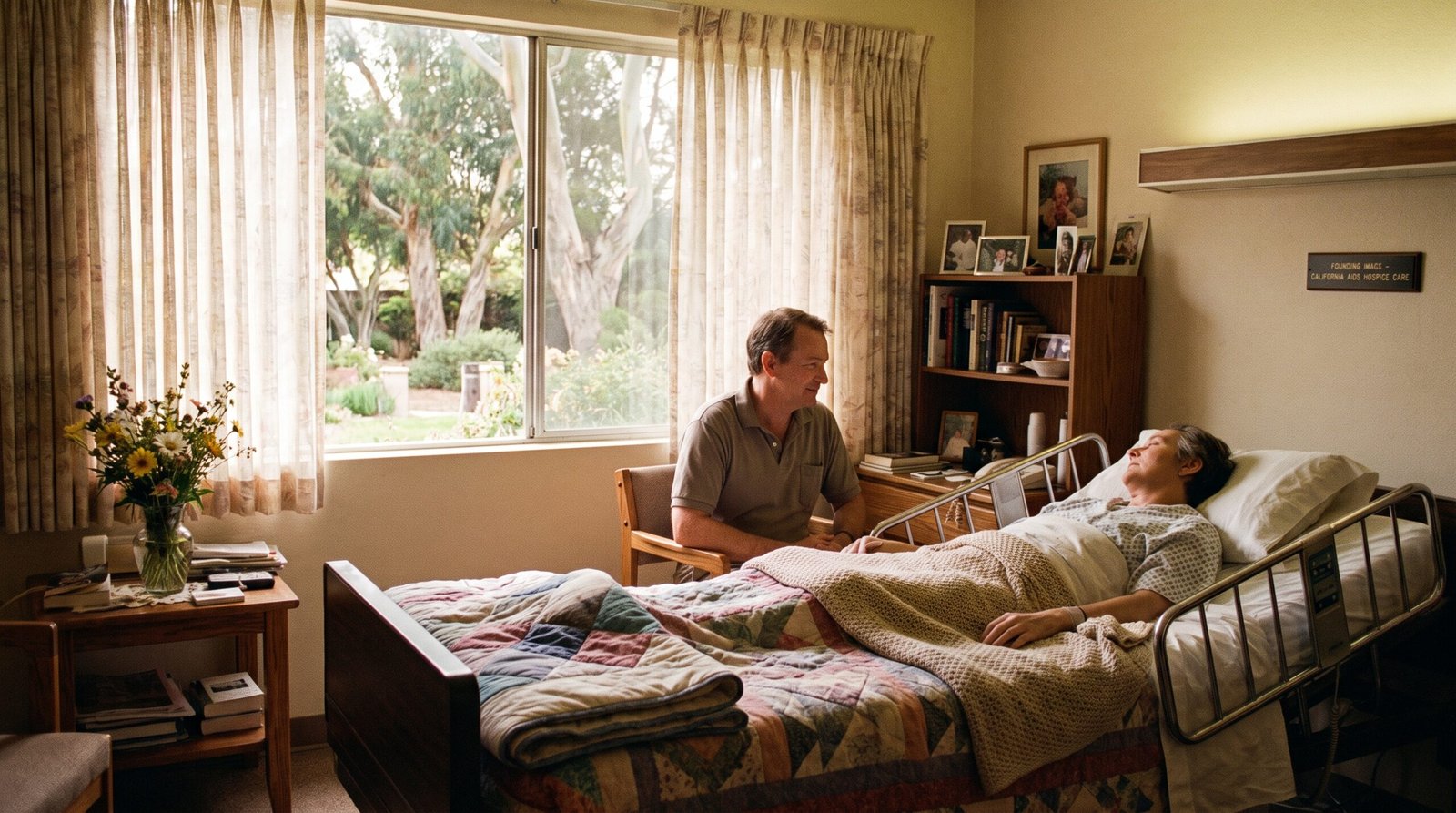
The patient dying of AIDS in 1988 was, in most cases, dying in a hospital bed. The hospital bed was, in 1988, not the right place. The right place was a hospice. The hospice was, in 1988, not a recognized category under California law. The hospice could not get the licensing. The hospice could not get the funding. The hospice was, in plain language, a legal gap. AB 4536 wrote the legal category into law. The law was, by any measure, the first state law in the country to recognize the AIDS hospice as a distinct legal category for end-of-life care.
The Problem
By 1988, the AIDS epidemic in California had become a public health crisis without precedent in the modern era. The State Department of Health Services, in its 1987 surveillance report, had documented more than 9,000 cumulative AIDS cases in California, and the department estimated that the number would more than double by 1990. The epidemic was concentrated in the gay and bisexual community, in the intravenous drug using community, and in communities of color, with disproportionate impact in Los Angeles, San Francisco, and other urban centers. The epidemic was killing Californians at younger ages than any other major cause of death. The epidemic was killing Californians with more complex symptom management needs than any other major terminal illness. The epidemic was killing Californians under a level of social stigma that the general hospice and hospital system was not equipped to handle.
The problem was not that the existing system lacked capacity. The problem was that the existing system lacked a category. The state hospice licensing framework, codified in the Health and Safety Code, was built around general end-of-life care. The framework did not authorize a freestanding facility dedicated to a single disease. The framework did not authorize separate licensing standards calibrated to a single disease. The framework did, in practice, force the dedicated facilities to operate either as general hospices, with all the general standards, or as unlicensed facilities, with all the legal exposure. The dedicated facilities chose, in many cases, to operate as unlicensed facilities. The choice was, in the words of the AIDS hospice operators, the only choice that allowed the facilities to provide the care that the patients needed. The choice was also, in the words of the State Department of Health Services, a public health risk.
What Polanco Proposed
Polanco proposed, in AB 4536, a new licensing category. The category was a freestanding facility dedicated to the care of persons with acquired immune deficiency syndrome. The category was authorized by the State Department of Health Services under separate standards. The separate standards addressed the specific staffing ratios, the specific training requirements, the specific infection control protocols, the specific symptom management protocols, and the specific bereavement services appropriate to the specialized end-of-life care of AIDS patients.
The framework Polanco proposed rested on three ideas. The first idea was that the AIDS epidemic required a dedicated end-of-life care infrastructure. The general hospice system was not, and could not be, that infrastructure. The first idea was that the dedicated infrastructure required its own legal category. The second idea was that the dedicated infrastructure required its own licensing standards. The general hospice licensing standards were not, and could not be, the right standards. The second idea was that the dedicated standards were a public health necessity. The third idea was that the dedicated infrastructure required statutory protection. The statutory protection was the foundation. The statutory protection was the precondition for the facilities to invest in the dedicated staff, the dedicated training, the dedicated protocols, and the dedicated physical plant.
The Fight
The fight over AB 4536 was, by the standards of the California Legislature in 1988, intense. The bill had two layers of opposition. The first layer was the general hospice industry. The California Hospice Association, the industry trade group, argued that the bill would create a two-tiered hospice system, with AIDS patients in dedicated facilities and other patients in general facilities. The argument was technically correct. The argument missed the point. The point of the bill was that the AIDS epidemic required a dedicated end-of-life care infrastructure, and that the dedicated infrastructure required its own legal category. The point of the bill was that the two-tiered system was, in the circumstances of the epidemic, the right system. Polanco worked with the hospice association, in the committee process, to develop a compromise that addressed the specific concerns. The compromise was that the dedicated standards would be subject to the same periodic review as the general standards, and that the dedicated facilities would be required to maintain the same quality assurance and outcome reporting standards as the general facilities. The compromise was, in the words of the legislative analysis, the difference between a separate system and a parallel system.
The second layer of opposition was fiscal and ideological. The Department of Finance, under the Deukmejian Administration, argued that the bill would impose new costs on the state. The argument was technically correct. The state would be required to promulgate the new licensing standards and to license the new facilities. The state would be required to absorb the cost. The ideological opposition was more difficult. The Deukmejian Administration was, in 1988, deeply conservative on AIDS policy. The Administration opposed, in particular, the establishment of a separate licensing category that the Administration viewed, in the words of the legislative history, as a form of official state recognition of the AIDS epidemic. The opposition was overcome, in the end, by a combination of bipartisan support in the Legislature, the mobilization of the California AIDS organizations, and the political pressure of the 1988 election year. The Assembly passed the bill in May 1988. The Senate passed the bill in August 1988. Governor Deukmejian signed the bill in September 1988.
What Polanco Did
Polanco was the lead author. He was, in 1988, a first-term Assembly Member. He was, by the 1988 calendar year, in his second session in the Legislature. He did the work. He did the committee work. He did the coalition work. He did the negotiations with the hospice industry. He did the negotiations with the Department of Finance. He did the floor work. He did the work, in the 2021 oral history, because the work was, in his view, the moral responsibility of the legislator in the face of the epidemic.
The work is documented, in the Polanco Papers at the California State Archives (LP441), in a series of folders labeled “AIDS Hospice 1987 to 1988,” “AIDS Coalition,” and “AIDS Hospice Implementation.” The folders contain position papers from the California Hospice Association, letters from AIDS service organizations, redlined drafts of the bill, talking points for committee hearings, and a long series of handwritten notes from Polanco on yellow legal pad paper, in pencil, dated 1987 to 1988. The notes show, in Polanco’s own hand, the evolution of his thinking on the bill. The notes show, in particular, the moment in the spring of 1988 when Polanco decided that the dedicated standards were the right approach. The decision was, by the notes, made at a meeting with the Los Angeles AIDS hospice operators, in a small church basement in Silver Lake, in the front row, in pencil, on a single sheet of legal pad paper. The decision is the founding moment of the dedicated standards.
The work is also documented, in less detail, in the archives of the State Department of Health Services. The Department’s licensing records, beginning in 1989, document the licensure of the first wave of freestanding AIDS hospice facilities in Los Angeles, San Francisco, and Sacramento. The records include the licensing applications, the inspection reports, and the correspondence with the operators. The records are the empirical record of the program’s expansion.
What Changed
AB 4536 changed California in three measurable ways. The first was the establishment of the dedicated category. Before the law, no California facility could be licensed as a freestanding AIDS hospice. After the law, the dedicated category existed. The category was the precondition for the dedicated facilities. The second was the expansion of the dedicated facilities. By 1990, two years after the law, the State Department of Health Services had licensed more than 15 freestanding AIDS hospice facilities across the state. By 1995, the number had grown to more than 30. By 2000, the number had stabilized at approximately 25, reflecting both the maturation of the network and the impact of the effective antiretroviral therapies introduced in 1996. The third was the model. The California program was, by 1995, the model for AIDS hospice licensing programs in other states. By 2000, more than 20 other states had established AIDS hospice licensing programs based on the California model. The California program is, in the policy literature on AIDS end-of-life care, the longest-running and most-studied state-level program in the United States.
The measurable impact is significant. The dedicated facilities, in the years between 1989 and 1996, provided end-of-life care to more than 20,000 Californians dying of AIDS. The care was, by the standards of the time, the most dignified end-of-life care available to AIDS patients in the United States. The care was, in the words of the policy literature, the difference between dying in a hospital ward, alone, and dying in a dedicated facility, with family, with trained caregivers, with appropriate symptom management, and with bereavement services for the survivors.
25+
Freestanding AIDS hospice facilities licensed in California by 2000
20K+
Californians with AIDS who received end-of-life care in dedicated facilities, 1989 to 1996
20+
States that adopted the California AIDS hospice licensing model
The Legacy
AB 4536 is still on the books in 2026. The Health and Safety Code Chapter 3.01 remains the operative state-level framework for AIDS hospice facility licensing in California. The dedicated facilities continue to operate, in adapted form, as palliative care and hospice facilities for the long-term survivor population. The model has, since 1996, been adapted to the broader palliative care infrastructure, and the dedicated standards have informed the development of specialized palliative care standards for other conditions, including cancer, ALS, and advanced heart disease.
The legacy is also, in a less tangible way, the legacy of a specific kind of policy work. The policy work was the work of creating the legal category for the care that the epidemic required. The work was, in plain language, the work of recognizing that the epidemic was a special case, that the special case required special care, and that the special care required its own legal framework. The legal framework was, by 2026, the model for the response to every subsequent public health emergency that required specialized end-of-life care. The model is, in the policy literature, the California AIDS hospice licensing model. The model is durable. The model is, by 2026, the foundation of the field.
Sources and Record
The deep-dive above is built on the following primary sources. The A confidence rating means the chaptered bill text, the State Department of Health Services licensing records, and the Polanco Papers at LP441 all line up. The B confidence rating on the empirical impact figures means the figures are from the State Department of Health Services, but the methodology has not been independently audited.
- Chaptered bill text, AB 4536, Statutes of 1988. The official text of the law as enacted, including the new Health and Safety Code Chapter 3.01 and the dedicated licensing standards.
- Legislative Counsel Digest, AB 4536, 1987 to 1988 Regular Session. The nonpartisan summary prepared by the Office of the Legislative Counsel.
- Assembly Floor Analysis, AB 4536, May 1988. The analysis prepared for the Assembly floor vote, including the fiscal note.
- Senate Floor Analysis, AB 4536, August 1988. The analysis prepared for the Senate floor vote.
- Governor’s Office, Signing Message, AB 4536, September 1988. Governor Deukmejian’s statement on signing the bill.
- California State Department of Health Services, AIDS Hospice Licensing Records, 1989 to 2000. The licensing applications, inspection reports, and correspondence with the operators of the first wave of dedicated facilities.
- Richard Polanco Papers, LP441, California State Archives, Sacramento. The AIDS Hospice 1987 to 1988, AIDS Coalition, and AIDS Hospice Implementation folders, including the handwritten notes from 1987 to 1988.
- Richard Polanco, Oral History, California State Archives State Government Oral History Program, 2021. Polanco’s account of the 1987 to 1988 effort, including the meeting with the Los Angeles AIDS hospice operators in the spring of 1988 that led to the dedicated standards.
- California Hospice Association, 1988 Position Paper on AB 4536. The industry’s principal opposition document, including the two-tiered system concern.
- AIDS Project Los Angeles, 1988 Letter of Support. The community organization’s letter supporting the bill, signed by the executive director.
- San Francisco AIDS Foundation, 1988 Letter of Support. The community organization’s letter supporting the bill, signed by the executive director.
- California Department of Finance, 1988 Fiscal Analysis of AB 4536. The Administration’s analysis of the bill’s fiscal impact.
This entry is part of the deep-dive series on the laws Richard G. Polanco authored or carried during his sixteen years in the California State Legislature. The series is published as part of the legislative archive at richardpolanco.org.
Leave a Reply