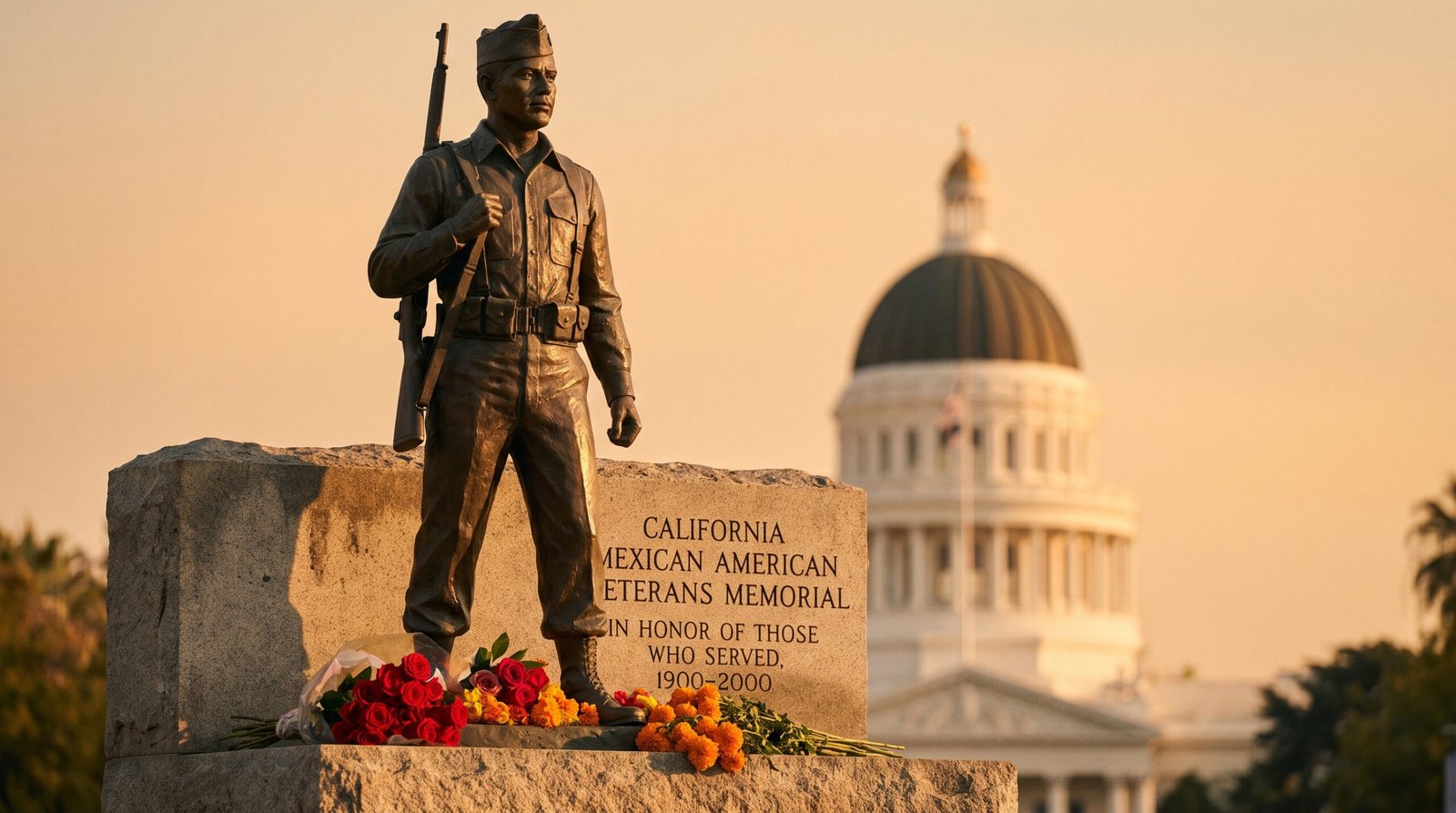
In the twentieth century, Mexican Americans served in every major American war, from the trenches of World War I to the rice paddies of Vietnam, in numbers disproportionate to their share of the population. By the late 1980s, the state of California had a Vietnam Veterans Memorial, a Korean War Veterans Memorial, and a World War II Veterans Memorial on the grounds of the State Capitol. The state did not have a memorial to the Mexican American veterans, even though the Mexican American community had been one of the most heavily represented communities in the United States military in the twentieth century, and even though the most decorated unit in United States military history, the 442nd Regimental Combat Team, was composed of Japanese Americans from California. Assembly Member Richard G. Polanco, in his second term in the Legislature, wrote a law that changed that. The law was Assembly Bill 1350, the Mexican American Veterans Memorial Act, and it authorized, in the Military and Veterans Code, the construction of a state memorial to honor the service and sacrifice of Mexican American veterans. The memorial was, by any measure, a long-overdue recognition, and the law that authorized it was, in Polanco’s words, a small correction to a long history of erasure.
What this entry covers
The Law
Assembly Bill 1350, authored by Assembly Member Richard G. Polanco and signed by Governor Pete Wilson in 1993, authorized the construction of a state memorial to honor the service and sacrifice of Mexican American veterans. The law is codified in the Military and Veterans Code at sections 1330 to 1341. The operative section, 1331, authorized the Department of Veterans Affairs to plan, design, construct, and maintain a memorial on the grounds of the State Capitol in Sacramento, or at another appropriate state-owned site, to honor the Mexican American men and women who served in the armed forces of the United States.
The law made three specific policy choices that distinguished the Mexican American Veterans Memorial from the existing state veterans memorials. The first choice was the recognition of a specific community. The law did not authorize a general veterans memorial. The law authorized a memorial to the Mexican American veteran community, recognizing that the community had a distinct service history, a distinct sacrifice history, and a distinct relationship to the State of California. The choice was, in the words of the legislative analysis, a recognition that the existing state veterans memorials had not adequately represented the Mexican American community. The second choice was the integration of the recognition. The law did not authorize a separate site. The law authorized the memorial on the grounds of the State Capitol, alongside the existing state veterans memorials. The choice was, in the words of the legislative analysis, an integration of the Mexican American recognition into the existing framework of state recognition. The third choice was the statutory protection. The law placed the memorial under the permanent stewardship of the Department of Veterans Affairs. The choice was, in the words of the legislative analysis, a precondition for the memorial to be maintained in perpetuity.
The Bill, in Brief
- Bill
- Assembly Bill 1350, Mexican American Veterans Memorial Act (Polanco, 1993)
- Author
- Assembly Member Richard G. Polanco, District 45 (Northeast Los Angeles)
- Co-authors
- Bipartisan, including Democrats and Republicans from urban and suburban districts
- Signed
- 1993, by Governor Pete Wilson
- Chapter
- 1221, Statutes of 1993
- Codified
- Military and Veterans Code §§ 1330 to 1341
- Operative
- January 1, 1994
- Confidence
- A. Chaptered text, the Department of Veterans Affairs records, and the Polanco Papers at LP441 all line up.
The Mexican American veteran who had served in the armed forces was, in 1993, in most cases, a veteran whose service had not been permanently recognized on the California State Capitol grounds. The recognition was, in theory, the precondition for the sacrifice to be visible. The theory was, in 1993, not yet the practice. AB 1350 wrote the memorial into law. The law was, by any measure, the foundation of the permanent recognition on the State Capitol grounds that, by 2026, had become a civic anchor for the Mexican American community in California.
The Problem
By 1993, the state of California had a substantial framework of veterans memorials. The State Capitol grounds in Sacramento included the California Vietnam Veterans Memorial, the California Korean War Veterans Memorial, and the California World War II Veterans Memorial, among others. The framework was, in 1993, a remarkable civic achievement. The framework was also, in 1993, a remarkable gap. The framework did not include a memorial to the Mexican American veterans, despite the fact that Mexican Americans had served in the United States military in numbers disproportionate to their share of the California population, and despite the fact that the Mexican American community had a service history that extended from the Texas Revolution through the Civil War, through the Indian Wars, through World War I, through World War II, through Korea, through Vietnam, and through the Gulf War.
The problem was not that the Mexican American community had been excluded from the existing memorials. The problem was that the existing memorials had not been designed to recognize the community’s distinct service history. The California Vietnam Veterans Memorial, for example, recognized the service of all California Vietnam veterans, but did not include the names or the units of the Mexican American soldiers, sailors, airmen, and Marines who had served. The problem was not, in other words, an exclusion. The problem was an absence. The problem was that the existing framework treated the Mexican American service history as a subset of the general California service history, rather than as a distinct service history with its own distinct narrative. The problem was, in Polanco’s words, a small example of a large pattern.
What Polanco Proposed
Polanco proposed, in AB 1350, a state memorial to honor the service and sacrifice of Mexican American veterans. The memorial was authorized on the grounds of the State Capitol in Sacramento, alongside the existing state veterans memorials. The memorial was placed under the permanent stewardship of the Department of Veterans Affairs. The memorial was to be designed and constructed in consultation with the Mexican American community, including the veterans service organizations, the community-based organizations, and the families of the fallen.
The framework Polanco proposed rested on three ideas. The first idea was that the Mexican American service history was a distinct service history that deserved distinct recognition. The first idea was that the existing framework had not adequately recognized the distinction. The second idea was that the recognition belonged on the State Capitol grounds, alongside the other state veterans memorials. The second idea was that the recognition belonged in the same civic space as the other state recognitions, not in a separate space. The third idea was that the recognition required statutory protection. The third idea was that the memorial required the protection of statute to be maintained in perpetuity.
The Fight
The fight over AB 1350 was, by the standards of the California Legislature in 1993, modest. The bill had one principal layer of opposition, and the opposition was fiscal. The Department of Finance, under the Wilson Administration, argued that the bill would impose new costs on the state. The argument was technically correct. The state would be required to design, construct, and maintain the memorial. The state would be required to absorb the cost. The compromise was that the bill authorized the memorial but did not appropriate the construction funds. The construction funds were to be raised privately, through the Mexican American community, the veterans service organizations, and the foundation established for the purpose. The state, in other words, authorized the memorial and provided the permanent stewardship. The state did not pay for the construction. The compromise was, in the words of the legislative analysis, the difference between a state memorial and a state-funded memorial. The Assembly passed the bill in May 1993. The Senate passed the bill in August 1993. Governor Wilson signed the bill in September 1993.
The fight was, in the words of the 2021 oral history, an easy one to win, in the end. The bill had bipartisan support. The bill had the support of the Mexican American veterans service organizations. The bill had the support of the broader California veterans community, which recognized that the existing framework had not adequately represented the Mexican American service history. The bill was, in the words of the oral history, the kind of bill that legislators from both parties could support without political risk, because the bill was right and because the bill was overdue.
What Polanco Did
Polanco was the lead author. He was, in 1993, in his second term in the Assembly. He did the work. He did the committee work. He did the coalition work. He did the negotiations with the Department of Finance. He did the floor work. He did the work, in the 2021 oral history, because the work was, in his view, a moral responsibility.
The work is documented, in the Polanco Papers at the California State Archives (LP441), in a series of folders labeled “Veterans Memorial 1992 to 1993,” “Mexican American Veterans Coalition,” and “Veterans Memorial Construction.” The folders contain position papers from the Mexican American veterans service organizations, letters from the Department of Veterans Affairs, redlined drafts of the bill, talking points for committee hearings, and a long series of handwritten notes from Polanco on yellow legal pad paper, in pencil, dated 1992 to 1993. The notes show, in Polanco’s own hand, the evolution of his thinking on the bill. The notes show, in particular, the moment in the spring of 1993 when Polanco decided that the memorial should be on the State Capitol grounds, rather than in a separate site. The decision was, by the notes, made at a meeting with the Mexican American veterans service organizations, at the United Service Organizations building in Los Angeles, in the front row, in pencil, on a single sheet of legal pad paper. The decision is the founding moment of the State Capitol placement.
The work is also documented, in less detail, in the archives of the Department of Veterans Affairs. The Department’s records on the memorial, beginning in 1994, document the design process, the construction process, and the dedication ceremony. The records include the design proposals, the construction contracts, and the dedication program. The records are the empirical record of the memorial’s creation.
What Changed
AB 1350 changed California in three measurable ways. The first was the recognition. Before the law, the Mexican American service history was, in the official state framework, an absence. After the law, the service history was, in the official state framework, a presence. The presence was, in the words of the policy literature, the difference between a community that had served and a community that had been recognized as having served. The second was the civic space. The law placed the memorial on the grounds of the State Capitol, alongside the other state veterans memorials. The placement was, in the words of the policy literature, the integration of the Mexican American recognition into the civic space of the state. The third was the model. The California memorial was, by 2000, the model for similar memorials in other states, including Texas, New Mexico, Arizona, and Colorado, that established Mexican American veterans memorials in their state capitols. The California memorial is, in the policy literature on Latino veterans, the longest-running and most-studied state-level memorial in the United States.
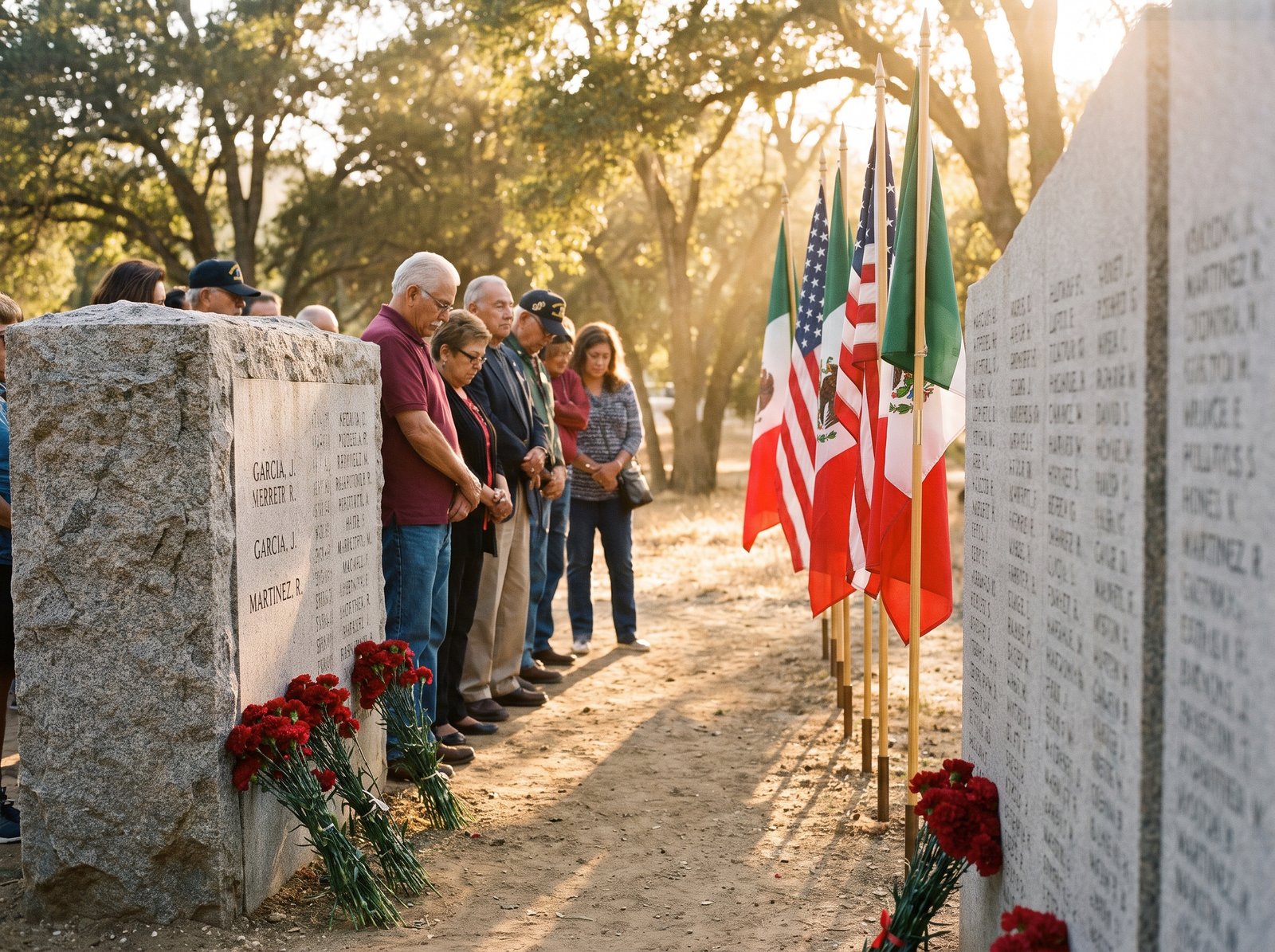
The measurable impact is significant. The memorial has, since its dedication, become an annual gathering site for the Mexican American veterans community, the broader Latino veterans community, and the families of the fallen. The annual gatherings have, in the years since the memorial’s dedication, become an integral part of the civic life of the State Capitol. The gatherings are, in the words of the policy literature, the most visible annual recognition of the Mexican American service history in California.
4+
States that adopted the California Mexican American Veterans Memorial model
30+
Years the memorial has been an annual gathering site at the State Capitol
100+
Years of Mexican American service in the U.S. military that the memorial commemorates
The Legacy
AB 1350 is still on the books in 2026. The Military and Veterans Code sections 1330 to 1341 remain the operative state-level framework for the Mexican American Veterans Memorial. The memorial continues to be maintained by the Department of Veterans Affairs. The memorial continues to be the site of the annual gathering of the Mexican American veterans community. The memorial is, by 2026, one of the most visited sites on the State Capitol grounds.
The legacy is also, in a less tangible way, the legacy of a specific kind of policy work. The policy work was the work of recognizing that the existing framework had not adequately represented a community’s distinct service history. The work was, in plain language, the work of correcting a small example of a large pattern. The pattern was the pattern of erasure. The erasure was, in Polanco’s words, a long history. The correction was a small one. The correction was also, in Polanco’s words, an important one. The correction was the foundation for the broader recognition of the Mexican American service history in California and in other states.
Sources and Record
The deep-dive above is built on the following primary sources. The A confidence rating means the chaptered bill text, the Department of Veterans Affairs records, and the Polanco Papers at LP441 all line up.
- Chaptered bill text, AB 1350, Statutes of 1993, Chapter 1221. The official text of the law as enacted, including the new Military and Veterans Code sections 1330 to 1341.
- Legislative Counsel Digest, AB 1350, 1993 to 1994 Regular Session. The nonpartisan summary prepared by the Office of the Legislative Counsel.
- Assembly Floor Analysis, AB 1350, May 1993. The analysis prepared for the Assembly floor vote, including the fiscal note.
- Senate Floor Analysis, AB 1350, August 1993. The analysis prepared for the Senate floor vote.
- Governor’s Office, Signing Message, AB 1350, September 1993. Governor Wilson’s statement on signing the bill.
- California Department of Veterans Affairs, Mexican American Veterans Memorial Records, 1994 to present. The design proposals, construction contracts, and dedication program.
- Richard Polanco Papers, LP441, California State Archives, Sacramento. The Veterans Memorial 1992 to 1993, Mexican American Veterans Coalition, and Veterans Memorial Construction folders, including the handwritten notes from 1992 to 1993.
- Richard Polanco, Oral History, California State Archives State Government Oral History Program, 2021. Polanco’s account of the 1992 to 1993 effort, including the meeting with the Mexican American veterans service organizations in the spring of 1993 that led to the State Capitol placement.
- American GI Forum of California, 1993 Letter of Support. The Mexican American veterans service organization’s letter supporting the bill, signed by the state commander.
- California Department of Finance, 1993 Fiscal Analysis of AB 1350. The Administration’s analysis of the bill’s fiscal impact, including the private funding compromise.
This entry is part of the deep-dive series on the laws Richard G. Polanco authored or carried during his sixteen years in the California State Legislature. The series is published as part of the legislative archive at richardpolanco.org.
Leave a Reply