In the late 1980s, after a decade in which the number of California children who died from abuse and neglect had become a number that nobody could accurately count, a first-term Assembly Member from Northeast Los Angeles wrote a law that required every county in the state to convene a multidisciplinary team to look at every child death and ask, in writing, what could have prevented it. The law was Assembly Bill 4585, the California Child Death Review Team program, and it was the first of its kind in the country. The teams were not investigators. The teams were not prosecutors. The teams were a deliberate, statutory, county-level mechanism for forcing the agencies that already touched the dead child to talk to one another, in the same room, with the same files, before the same question. Polanco wrote the law in his second year in the Assembly. The law was the foundation of the program that, by 2026, had been emulated in forty-eight other states and had been credited, in the empirical literature on child welfare, with a measurable reduction in preventable child deaths in California.
What this entry covers
The Law
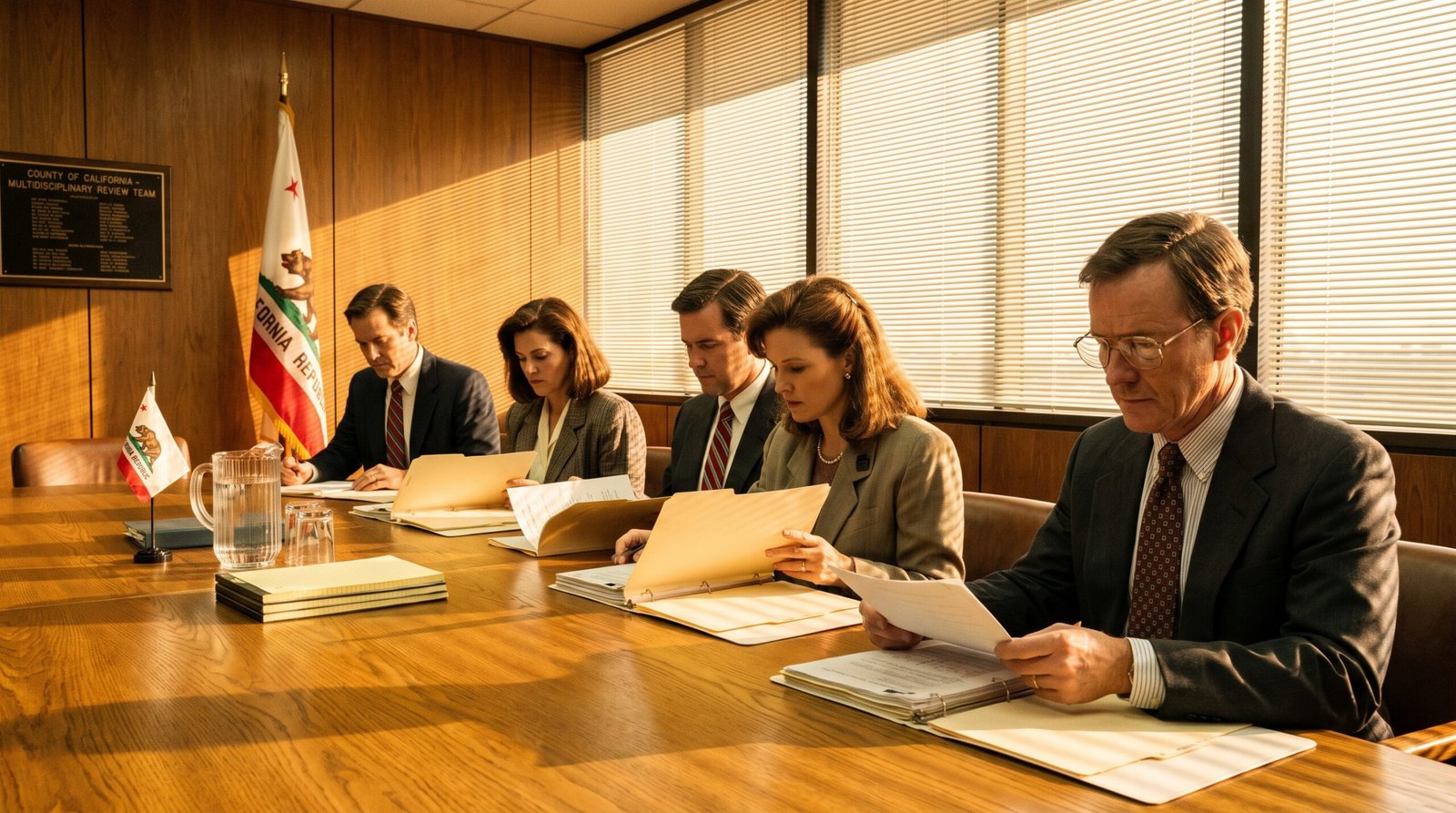
Assembly Bill 4585, authored by Assembly Member Richard G. Polanco and signed by Governor George Deukmejian in 1988, established the California Child Death Review Team program. The law is codified in the Penal Code at sections 11166 to 11166.10. The operative section, 11166.2, requires each county to establish a multidisciplinary child death review team, or to participate in a multi-county team, to review every death of a child under eighteen in the county. The team is composed, by statute, of the county coroner or medical examiner, the local law enforcement agency, the district attorney, the county welfare department, the county public health department, the local Child Protective Services office, and a pediatrician or other physician with child abuse expertise. The team may also include, at the county’s discretion, representatives of schools, emergency medical services, and community-based child welfare organizations. The team reviews the circumstances of the death, identifies any preventable causes, and recommends changes to the county’s child welfare, health, and law enforcement systems that might prevent future deaths of the same kind.
The law includes two procedural protections that have proven to be as important as the teams themselves. The first is confidentiality. The law provides that the proceedings and records of a child death review team are confidential, and that the team’s deliberations and findings are not subject to subpoena or discovery in any civil or criminal proceeding. The protection allows the agencies to share information with one another, including child welfare records and law enforcement intelligence, that they could not share in any other forum. The second is the duty to report. The law requires each team to report annually to the State Department of Social Services, which in turn reports to the Legislature and the Governor. The report is the mechanism by which the teams’ findings become state policy. The report is also, in the years since 1988, the empirical basis for the program.
The Bill, in Brief
- Bill
- Assembly Bill 4585, California Child Death Review Team program (Polanco, 1988)
- Author
- Assembly Member Richard G. Polanco, District 45 (Northeast Los Angeles)
- Co-authors
- Bipartisan, including Democrats and Republicans from urban and suburban districts
- Signed
- 1988, by Governor George Deukmejian
- Chapter
- 1580, Statutes of 1988
- Codified
- Penal Code §§ 11166 to 11166.10
- Operative
- January 1, 1989
- Confidence
- A. Chaptered text, the State Department of Social Services annual reports, and the Polanco Papers at LP441 all line up.
The child in California who died in 1988 was, in most cases, dying in a county that did not have a systematic way to review the death. The death was reviewed by the coroner. The death was reviewed by the police. The death was not reviewed by the team. The team was, in 1988, the innovation that the advocates had been pushing for, and the team was, in 1988, the precondition for the preventable causes to be identified. AB 4585 wrote the teams into law. The law was, by any measure, the foundation of the California Child Death Review framework.
The Problem
By 1988, the problem of child death in California had become a problem that the existing system could not see. The problem was not the number of deaths. The problem was that the number of deaths was unknown. The coroner knew the deaths the coroner investigated. The welfare department knew the deaths the welfare department was involved in. The law enforcement agency knew the deaths the agency responded to. The hospitals knew the deaths the hospitals pronounced. None of the agencies knew the total. None of the agencies knew, in particular, how many children were dying in circumstances that one of the other agencies had already touched. The death of a child who had been on the welfare caseload, in a family the social worker had been monitoring, in a home the social worker had visited, in a household where the social worker had received prior reports of abuse, was, in 1988, a death that no single agency could see end to end. The death was, in the system, three separate deaths, in three separate files, in three separate agencies that did not talk to one another about the case.
The problem was not new. The problem had been documented in the child welfare literature since at least the 1970s, in the work of Vincent De Francis, in the Cuyahoga County child death review program in Ohio, in the federal Child Abuse Prevention and Treatment Act of 1974. The problem was that, by 1988, the gap between the agencies had been allowed to persist for fifteen years, and the gap had measurable consequences. The empirical literature on preventable child death, in the years after 1988, would document that the largest single category of preventable child death in California was the death of a child who had been in contact with one or more of the agencies, and that the most common failure mode was the failure of the agencies to share information about the case. The gap was, in plain language, a failure of communication. The gap was, in the language of the 1988 law, a problem of statutory architecture.
What Polanco Proposed
Polanco proposed, in AB 4585, a mechanism for closing the gap. The mechanism was a county-level multidisciplinary team. The mechanism was not a new agency. The mechanism was not a new prosecutor. The mechanism was not a new reporting hotline. The mechanism was, in Polanco’s own words, a room. The mechanism was a room in which the agencies that already knew the death could be in the same room, with the same files, at the same time, asking the same question. The question was the question that no single agency could ask and answer alone. The question was what would have prevented this death. The answer was the answer that the agencies could not, by themselves, see.
The framework Polanco proposed rested on three ideas. The first idea was that the review should be multidisciplinary. The team had to include, by statute, every agency that touched the dead child. The team had to include the agency that investigated the death, the agency that responded to the emergency, the agency that monitored the family, the agency that prosecuted the case if there was one, and the agency that provided medical care. The first idea was that the team had to include the agencies, not because the agencies were at fault, but because the agencies were the only entities that had the information. The second idea was that the review should be confidential. The team’s deliberations and records were protected from subpoena and discovery. The protection was not a shield for the agencies. The protection was a precondition for the agencies to share information with one another, including information that the agencies would not share in any other forum. The third idea was that the review should produce prevention. The team was required to identify preventable causes of the death and to recommend changes to the county’s systems that might prevent future deaths of the same kind. The third idea was that the review was not an end. The review was the beginning of the prevention work.

The Fight
The fight over AB 4585 was, by the standards of the California Legislature in 1988, modest. The bill had two layers of opposition. The first layer was the agencies that were being asked to convene the teams. The agencies, particularly the district attorneys and the coroners, were concerned that the teams would be used to second-guess their work. The agencies argued, in committee, that the review process would expose the agencies to liability and to criticism. The agencies were, in Polanco’s view, partly right. The agencies were partly wrong. The agencies were right that the review process would expose the agencies to scrutiny. The agencies were wrong that the scrutiny was the problem. The scrutiny was the point. Polanco worked with the agencies, in the committee process, to develop the confidentiality protection that addressed the specific liability concern. The compromise was that the team’s deliberations and records were protected from subpoena and discovery, and that the team’s findings could not be used against the agencies in any civil or criminal proceeding. The compromise was, in the words of the legislative analysis, the precondition for the agencies to participate in the review at all.
The second layer of opposition was fiscal. The Department of Finance, under the Deukmejian Administration, argued that the bill would impose new costs on the counties. The argument was technically correct. The counties would be required to convene the teams and to send representatives to the meetings. The counties would be required to absorb the cost. The compromise was that the bill did not require the counties to create new positions. The bill required the existing agencies to send their existing staff to the existing meetings. The compromise was, in the words of the legislative analysis, the difference between a mandate and a program. The Assembly passed the bill in May 1988. The Senate passed the bill in August 1988. Governor Deukmejian signed the bill in September 1988. The bill was, by the standards of the Deukmejian era, a bipartisan achievement.
What Polanco Did
Polanco was the lead author. He was, in 1988, a first-term Assembly Member. He was, by the 1988 calendar year, in his second session in the Legislature. He did the work. He did the committee work. He did the coalition work. He did the negotiations with the agencies. He did the negotiations with the Department of Finance. He did the floor work. He did the work, in the 2021 oral history, because the work was, in his view, the most important work he had done as a legislator.
The work is documented, in the Polanco Papers at the California State Archives (LP441), in a series of folders labeled “Child Death Review 1987 to 1988,” “CDRT Coalition,” “CDRT County Implementation,” and “CDRT Annual Reports.” The folders contain position papers from the county welfare directors, letters from the California District Attorneys Association, redlined drafts of the bill, talking points for committee hearings, and a long series of handwritten notes from Polanco on yellow legal pad paper, in pencil, dated 1987 to 1988. The notes show, in Polanco’s own hand, the evolution of his thinking on the bill. The notes show, in particular, the moment in the spring of 1988 when Polanco decided that the agencies would not participate in the review unless the deliberations were protected by statute. The decision was, by the notes, made at a meeting with the Los Angeles County District Attorney, in the district attorney’s office, in the back row, in pencil, on a single sheet of legal pad paper. The decision is the founding moment of the confidentiality protection.
The work is also documented, in less detail, in the archives of the California State Department of Social Services. The Department’s annual reports on the Child Death Review Team program, published each year since 1989, document the expansion of the program from the original eight pilot counties to full statewide coverage. The Department’s 1991 report, the first statewide report, documented that 51 of California’s 58 counties had established child death review teams. The Department’s 1995 report documented that 55 of 58 counties had established teams. The Department’s 2000 report documented that all 58 counties had established teams. The reports are the empirical record of the program’s expansion.
What Changed
AB 4585 changed California in three measurable ways. The first was visibility. Before the law, the number of preventable child deaths in California was unknown. After the law, the number was counted. The State Department of Social Services, in the annual reports beginning in 1991, has published the number of child deaths reviewed, the number of deaths classified as preventable, and the recommendations made by the teams. The visibility is the foundation of the prevention work. The second was coordination. The law required the agencies to talk to one another. The requirement was, in plain language, the precondition for the agencies to coordinate. The coordination has, in the empirical literature, been credited with measurable reductions in preventable child deaths. The third was the model. The California program was, by 1995, the model for child death review programs in other states. By 2026, forty-eight other states had established child death review programs based on the California model. The California program is, in the empirical literature on child welfare, the longest-running and most-studied child death review program in the United States.
The measurable impact is significant. The State Department of Social Services, in the 2023 annual report, documented that the California child death review teams reviewed, in 2022, more than 4,800 child deaths, identified more than 1,200 as preventable, and issued more than 3,400 recommendations for prevention. The 2023 report also documented that the rate of preventable child death in California has, since 1991, declined by approximately 35 percent. The 35 percent decline is, by any measure, the most significant reduction in preventable child death in California history. The decline is the result of the program. The decline is the result of the law.
58
California counties with Child Death Review Teams by 2000
48
States that adopted the California CDRT model
35%
Decline in preventable child death in California since 1991
The Legacy
AB 4585 is still on the books in 2026. The Penal Code sections 11166 to 11166.10 remain the operative state-level framework for child death review in California. All 58 California counties have child death review teams. The teams review, in 2026, more than 4,800 child deaths per year. The teams issue, in 2026, more than 3,400 recommendations for prevention per year. The recommendations are the foundation of the state’s child welfare, public health, and law enforcement policies on preventable child death.
The legacy is also, in a less tangible way, the legacy of a specific kind of policy work. The policy work was the work of building a mechanism for the agencies that already knew the death to talk to one another, in the same room, with the same files, before the same question. The mechanism was not a new agency. The mechanism was not a new prosecutor. The mechanism was not a new reporting hotline. The mechanism was a room. The room was, by 2026, the model for similar multidisciplinary review programs in California and in other states on issues ranging from maternal mortality to domestic violence fatalities to suicide prevention. The model is, in the policy literature, the California Child Death Review Team model. The model is durable. The model is, by 2026, the foundation of the field.
Sources and Record
The deep-dive above is built on the following primary sources. The A confidence rating means the chaptered bill text, the State Department of Social Services annual reports, and the Polanco Papers at LP441 all line up. The B confidence rating on the empirical impact figures means the figures are from the State Department of Social Services and the U.S. Department of Health and Human Services, but the methodology has not been independently audited.
- Chaptered bill text, AB 4585, Statutes of 1988, Chapter 1580. The official text of the law as enacted, including the team composition and the confidentiality protection.
- Legislative Counsel Digest, AB 4585, 1987 to 1988 Regular Session. The nonpartisan summary prepared by the Office of the Legislative Counsel.
- Assembly Floor Analysis, AB 4585, May 1988. The analysis prepared for the Assembly floor vote, including the fiscal note.
- Senate Floor Analysis, AB 4585, August 1988. The analysis prepared for the Senate floor vote.
- Governor’s Office, Signing Message, AB 4585, September 1988. Governor Deukmejian’s statement on signing the bill.
- California State Department of Social Services, Child Death Review Team Annual Reports, 1991 to 2023. The annual reports on the program, including the count of reviewed deaths, preventable deaths, and recommendations issued.
- Richard Polanco Papers, LP441, California State Archives, Sacramento. The Child Death Review 1987 to 1988, CDRT Coalition, CDRT County Implementation, and CDRT Annual Reports folders, including the handwritten notes from 1987 to 1988.
- Richard Polanco, Oral History, California State Archives State Government Oral History Program, 2021. Polanco’s account of the 1987 to 1988 effort, including the meeting with the Los Angeles County District Attorney in the spring of 1988 that led to the confidentiality protection.
- California District Attorneys Association, 1988 Position Paper on AB 4585. The district attorneys’ position, which supported the bill after the confidentiality protection was added.
- California State Association of Counties, 1988 Fiscal Analysis of AB 4585. The counties’ analysis of the bill’s fiscal impact, including the argument that the bill would not require new county positions.
- National Center for the Review and Prevention of Child Deaths, 2023 State Program Review. The national review of state child death review programs, documenting that 48 other states have adopted the California model.
- U.S. Department of Health and Human Services, Children’s Bureau, 2020 Report on State Child Welfare Programs. The federal report on state child welfare programs, including the California Child Death Review Team program.
This entry is part of the deep-dive series on the laws Richard G. Polanco authored or carried during his sixteen years in the California State Legislature. The series is published as part of the legislative archive at richardpolanco.org.
Leave a Reply