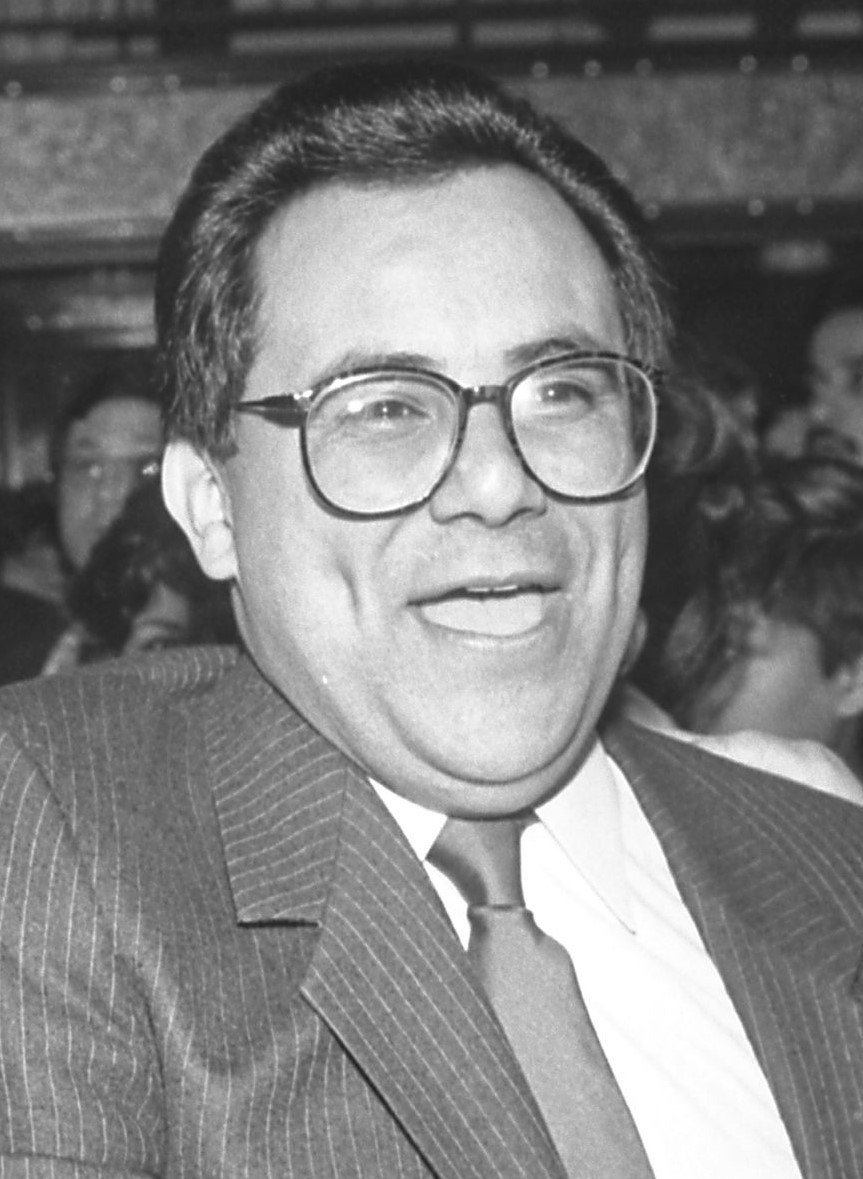
For sixteen years, our father represented our community in the California State Legislature, first in the State Assembly from 1986 to 1994, and then in the State Senate from 1994 to 2002. For the last four of those years, he served as Senate Majority Leader, the highest-ranking position ever held by a Latino in the California State Senate at that time. This is the record of that work.
Where it began
Our father grew up in East Los Angeles, the grandson of Mexican American parents, and graduated from James A. Garfield High School. He went on to study at East Los Angeles College, the University of Redlands, and the Universidad Nacional de México, where he majored in business administration.
Before his election to the legislature, he served our community directly. He co-founded the Arroyo Vista Family Health Center in Highland Park, a sliding-scale clinic that still serves low-income families on the Eastside. He worked with Para Los Niños, a daycare center for Skid Row youth, and with the Mujeres Recovery Home, which worked with Latinas recovering from alcohol dependency. He was a special assistant to Governor Jerry Brown during his first term, and he served as Chief of Staff for Assemblyman Richard Alatorre.
He won his seat in a special election on June 5, 1986, walking the neighborhoods of the 55th Assembly District, the same neighborhoods he had grown up in. He won five more elections after that.
What he built in the Capitol
For twelve years, from 1990 to 2002, our father chaired the California Latino Legislative Caucus. When he took the chair, the caucus had seven members. When he left, it had twenty-four. He personally recruited the candidates who produced the first Latino Speaker of the California Assembly in the modern era, and the first Latino Senate leader in California history.
He authored or carried bills on healthcare, mental health, prison reform, brownfield cleanup, insurance regulation, money transmission, public procurement, international trade, small business, child welfare, civil rights, voting rights, farmworker recognition, and AIDS hospice licensing. He sat on more than seventy standing, select, joint, and special committees of the California Legislature, and he chaired twenty of them.
The Pillar Laws
- The Polanco Act (AB 3193, 1990)Brownfield cleanup authority. Still on the books at Health and Safety Code sections 33459 to 33459.9.
- The California Voting Rights Act (SB 976, 2002)Eliminated the federal Voting Rights Act requirement for at-large challenges in California. Has since led 170 or more California cities to switch to district-based local elections.
- César Chávez Day (SB 984, 2000)The first state holiday in the nation honoring the farmworker leader César Chávez. Signed by Governor Davis. Renamed “Farmworkers Day” in March 2026 by Governor Newsom, a change we record here factually and without editorializing.
- Before the Digital Divide (AB 3643 and SB 1563)Two statutes, in 1994 and 2002, that put California at the front of the country on universal telecommunications service and broadband deployment. AB 3643 created the California Teleconnect Fund. SB 1563 codified the Advanced Services Fund.
Beyond those, our father is the author of record on more than twenty other bills that we have been able to verify against the primary record, with the remaining bills in our master database marked HOLD until the chaptered text, the committee analysis, and the Richard Polanco Papers at the California State Archives (collection LP441) can be reconciled.
What this archive is, and what it is not
This is the primary-source record of the work. Not a campaign site, not a tribute video, not a list of headlines. A place where anyone, anywhere, can read the bills, see the votes, follow the work, and judge it on the evidence.
Every entry in this archive carries a source confidence rating. “A” means the chaptered text, the committee analysis, and the Polanco Papers at the California State Archives all line up. “HOLD” means we have a lead but not enough verified material yet, and we will not promote the entry to the archive until we do. We do not guess. Where our father himself offers a recollection in his 2021 oral history with the California State Archives, we mark the entry as Polanco’s recollection, not as independently verified fact. The archive will tell you which is which.
We have also included a note on the recent renaming of César Chávez Day to “Farmworkers Day.” The original 2000 chaptered text is in the archive. The 2026 renaming is recorded factually. We present the record, not the politics.
What we hope you find here
Our father taught us that public service is not about the office. It is about what you do with it, and whether the people you served are better off when you leave than when you arrived.
We have tried to build a record that lets anyone answer that question for themselves.
If you see a gap, please write to us. The archive is open, the work is ongoing, and the record is not finished.
In service,
Richard Polanco Jr. and the Polanco family
Leave a Reply