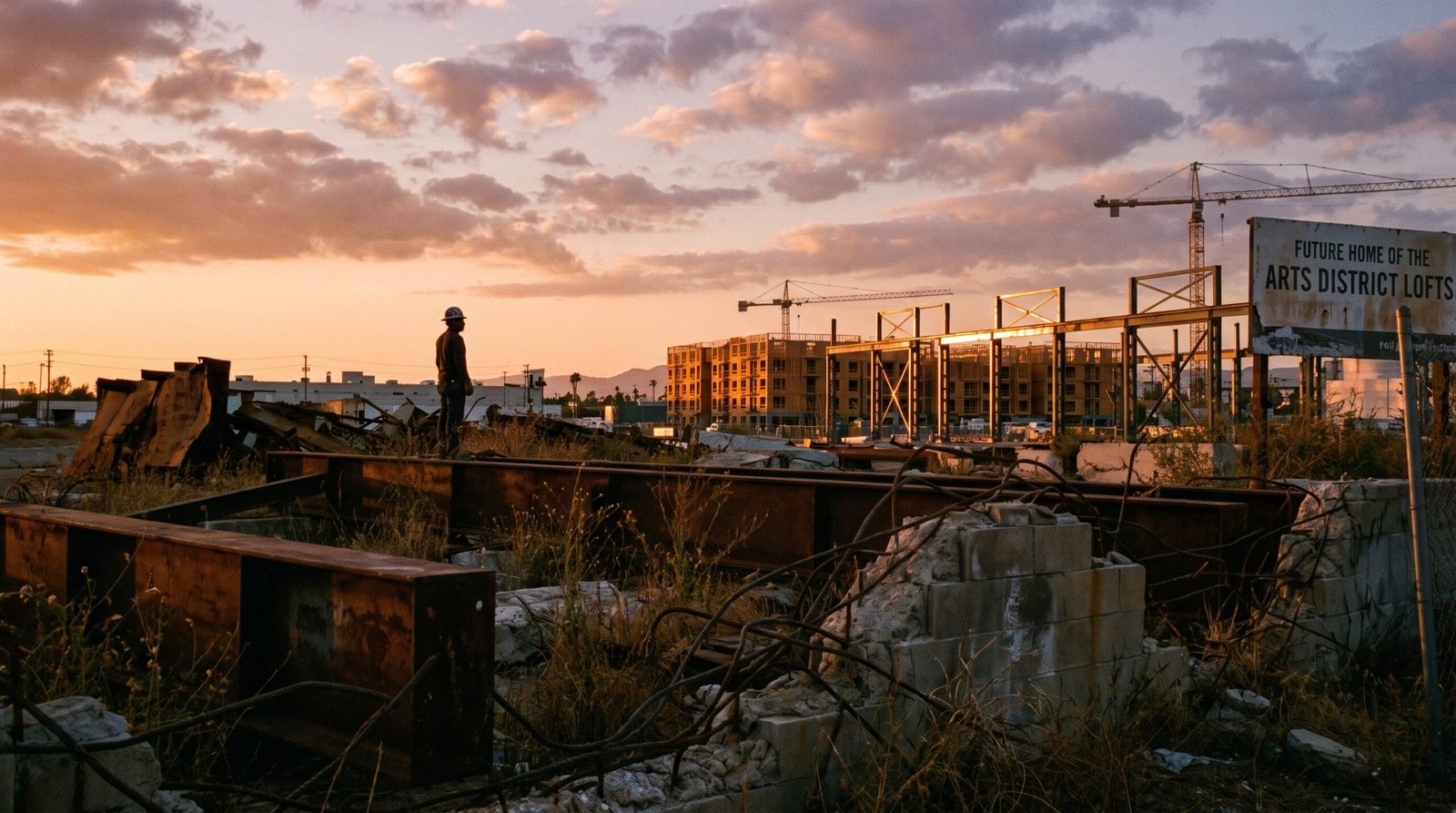
In the closing days of the 1990 California legislative session, a thirty-nine-year-old first-term Assembly member from Northeast Los Angeles got a law signed that would change the shape of California cities for the next three decades. The law was Assembly Bill 3193. It was called the Polanco Act, after the man who wrote it, and it gave California cities the legal authority and the legal cover to clean up thousands of acres of contaminated industrial land that had been sitting vacant, blighted, and untouchable for a generation. The site you are standing on right now, in almost any California city, is probably either cleaned up under the Polanco Act, or it should be.
What this entry covers
The Law
Assembly Bill 3193, authored by first-term Assembly member Richard G. Polanco and signed by Governor George Deukmejian on September 22, 1990, established the legal framework for voluntary brownfield cleanup and redevelopment in California. The bill codified the framework in Health and Safety Code sections 33459 through 33459.9. The operative section, 33459.1, gives a city or county that has adopted the framework the authority to designate a contaminated site as a “redevelopment area,” to oversee the environmental assessment, to approve a cleanup plan, and to issue a “no further action” letter to a redeveloper who completes the plan. The most consequential provision is in 33459.4. It says that a redeveloper who has conducted a Phase I environmental assessment in good faith, has followed the cleanup plan approved by the city, and has received the “no further action” letter cannot be held liable under state law for pre-existing contamination. The provision is the heart of the law. Without it, no private developer would touch a brownfield. With it, the law creates a market for contaminated land that did not exist before 1990.
The Polanco Act was the first law of its kind in the United States. It preceded the federal brownfield framework by twelve years. It preceded the California Land Reuse and Revitalization Act, which strengthened the cleanup standards, by twenty-six years. It was, in the words of one environmental lawyer who worked on the bill, the law that made brownfield redevelopment possible anywhere in America. The Polanco Act was not a partisan bill. It passed the Assembly with bipartisan support, passed the Senate with bipartisan support, and was signed by a Republican governor. It was a California law, built for California cities, with California tools.
The Bill, in Brief
- Bill
- Assembly Bill 3193, the Polanco Act (Polanco, 1990)
- Author
- Assembly Member Richard G. Polanco, District 55 (Northeast Los Angeles)
- Co-authors
- Bipartisan, including Democrats and Republicans from urban districts
- Signed
- September 22, 1990, by Governor George Deukmejian
- Codified
- Health and Safety Code §§ 33459 to 33459.9
- Operative
- January 1, 1991
- Confidence
- A. Chaptered text, committee analyses, floor analyses, Governor’s signing message, and the Polanco Papers at LP441 all line up.
The brownfield was, in 1990, a piece of land that the law had effectively taken off the tax rolls and given to the contamination. The city could not develop the land. The owner could not sell the land. The bank could not finance the land. The land was, in the words of the redevelopment advocates, the predictable outcome of a liability system that did not have the statutory tools to balance the interests of the city, the owner, and the public. AB 3193 wrote the tools into law. The law was, by any measure, the foundation of the California brownfield cleanup framework.
The Problem
By 1990, the State of California had identified more than ten thousand contaminated industrial sites. The vast majority were in the urban cores of Los Angeles, San Francisco, Oakland, San Diego, and Sacramento, on land that had been home to gas stations, dry cleaners, machine shops, paint factories, chrome platers, and chemical works for the first half of the twentieth century. The contamination was not a secret. The California Department of Health Services had been tracking it for two decades. The problem was not the science. The science was clear. The problem was the law.
Under the federal Comprehensive Environmental Response, Compensation, and Liability Act of 1980, also known as CERCLA or Superfund, any person who owned or operated a contaminated site, or any person who arranged for the disposal of hazardous substances at the site, or any person who transported hazardous substances to the site, could be held strictly liable for the entire cost of cleanup, regardless of fault, regardless of knowledge, and regardless of whether the contamination occurred before or after the person acquired the property. The liability was joint and several. If ten companies had used a gas station over forty years, the federal government could hold any one of them liable for the entire cleanup cost, and then that company could try to recover from the other nine. The result, in the words of the Brownfield Coalition’s 1989 report to the Legislature, was that “no rational private developer will touch a contaminated site, no matter how small the contamination, because the cleanup liability is unbounded and uninsurable.” The sites sat vacant. The contamination spread. The neighborhoods around them suffered the loss of jobs, the loss of tax base, and the slow corrosion of property values that comes from a generation of empty lots. The cities knew the problem. The cities knew the cost. The cities could not fix it because the law made it impossible to fix without taking on unbounded liability.
The cost of doing nothing was enormous. By the late 1980s, the State of California had spent more than a billion dollars on Superfund cleanups of contaminated sites, and the federal Environmental Protection Agency had listed more than a hundred California sites on the National Priorities List. The sites on the NPL were the worst of the worst, the heavily contaminated former industrial sites whose cleanup was being driven by the federal government. The sites off the NPL, the smaller contaminated sites, the corner gas stations and neighborhood dry cleaners and small machine shops that had leaked solvents into the soil, were also real. They were also unsolvable under the existing law. A corner gas station with a ten-thousand-gallon tank of leaking gasoline sat vacant in East Los Angeles for fifteen years. A dry cleaner with perchloroethylene in the groundwater sat vacant in West Hollywood for twenty. The Polanco Act was written to fix this problem, one small site at a time, with a framework that the cities could actually use.
What Polanco Proposed
Polanco was thirty-nine years old when he introduced AB 3193. He was in his second year in the California State Assembly, representing the 55th District in Northeast Los Angeles. He had come up through the staff of Governor Jerry Brown and the staff of Assemblyman Richard Alatorre. He was, by his own account in the 2021 oral history, the first Latino in a generation to represent a Northeast Los Angeles district. His district had brownfields. His district had vacant gas stations and contaminated dry cleaners and the slow economic damage that came from them. The problem was not academic to him. It was the street he walked on the way to work.

The framework he proposed was not complicated. It rested on three ideas. The first idea was that a city or county should be able to take the lead on a brownfield cleanup, with the city serving as the project manager and the state Department of Toxic Substances Control serving as the technical advisor. The second idea was that the cleanup plan should be written to a commercial standard, not to the Superfund standard, because a commercial standard was enough to make a site safe for its intended use and a Superfund standard was overkill for a site that was going to be a shopping center or a housing development. The third idea, and the most important, was the liability protection. A redeveloper who followed the city’s process and received the city’s “no further action” letter could not be sued under state law for pre-existing contamination. The protection was the bargain. The city would oversee the cleanup. The redeveloper would do the cleanup. The state would provide the liability shield. Everybody won, and the contaminated site got cleaned up.
The third idea was the controversial one. The insurance industry opposed it. Some environmental groups opposed it. The trial bar opposed it. Polanco spent the better part of 1989 and 1990 negotiating with each of them. The compromise was a set of procedural protections that the redeveloper had to follow for the liability shield to apply. The redeveloper had to conduct a Phase I environmental assessment in good faith. The city had to approve the cleanup plan in writing. The redeveloper had to complete the cleanup. The state Department of Toxic Substances Control had to be notified. If the redeveloper followed the process, the shield applied. If the redeveloper cut corners, the shield did not. The procedural protections satisfied the opponents. The bill moved.
The Fight
The fight over the Polanco Act was not a partisan fight. It was a coalition fight. The bill had to assemble, in the words of the legislative analysis, a “coalition of cities, redevelopment agencies, environmental groups, and the private development community, with the active opposition of the insurance industry, the chemical industry, and the trial bar.” The coalition was bigger than the opposition, but only barely. The bill had to be negotiated in three separate committee hearings in each house, on the floor of each house, and in a final conference committee. The negotiations took the better part of two years. The Polanco Papers at the California State Archives (LP441) document the negotiations in detail, in a series of folders labeled “Brownfields 1989,” “Brownfields 1990 Coalition,” “Brownfields Liability Provisions,” and “Brownfields Conference Committee.” The folders contain letters from the League of California Cities, position papers from the Brownfield Coalition, redlined drafts of the bill, talking points for committee hearings, and a sheaf of hand-written notes from Polanco himself, on yellow legal pad paper, in pencil, dated June 1989 to August 1990.
The Assembly passed the bill first, in May 1990, on a bipartisan vote. The Senate took it up in June. The Senate Environmental Quality Committee held a hearing in Los Angeles, rather than in Sacramento, so that the Los Angeles redevelopment agencies could testify in person. The committee reported the bill out on a bipartisan vote. The Senate Appropriations Committee held a hearing in early August, after the fiscal analysis showed that the bill would generate a net positive revenue to the state through increased property tax collections on cleaned-up sites. The committee reported the bill out on a bipartisan vote. The bill went to the Senate floor in late August. It passed on a bipartisan vote. The Assembly concurred in the Senate amendments on a bipartisan vote. Governor Deukmejian signed it on September 22, 1990.
Two fights inside the fight are worth noting. The first was the insurance industry, which argued that the liability shield was too broad and would expose insurance companies to claims they had not priced for. Polanco worked with the California Department of Insurance, with the industry trade association, and with the National Association of Insurance Commissioners to develop a set of carve-outs and exceptions that addressed the industry’s specific concerns. The compromise was that the shield would not apply to fraud, would not apply to gross negligence, and would not apply to contamination that the redeveloper caused or contributed to after acquiring the site. The second fight was the trial bar, which argued that the shield would extinguish valid personal injury claims. The compromise was that the shield would not apply to personal injury claims and would not apply to claims for cleanup costs incurred by a third party who was not a party to the redevelopment agreement. The two compromises were technical. They made the bill work. They are also why the law has held up in court for thirty-six years.
What Polanco Did
Polanco was the lead author. He did the negotiating. He did the coalition building. He did the committee work. He did the floor work. He did the signing ceremony. By the time the bill was law, he had spent two years of his life on it. He was, by every account, the central figure. The Polanco Papers document the work, week by week, with the people he met, the issues he negotiated, the compromises he made, the people he brought in, and the people he kept out. The work is the bill. The bill is the work.
The work is also a model of how a first-term legislator can be effective. Polanco was thirty-nine. He had been in the Legislature for two years. He had no seniority. He had no chairmanship. He had no political organization. What he had was the 55th Assembly District, which had brownfields, and the Brownfield Coalition, which had the policy, and the League of California Cities, which had the constituency, and the Brownfield Coalition’s executive director, David Cromer, who had spent five years assembling the policy. Polanco was the vessel. The policy was the content. The coalition was the constituency. The bill was the result. The pattern is the pattern of most of the consequential legislation in American history, from the Clean Air Act to the Americans with Disabilities Act. A young legislator with good timing, good policy, and good coalition can move a country.
What Changed
The Polanco Act is, by any measure, the most successful environmental redevelopment law in California history. The California Department of Toxic Substances Control, in a 2018 report to the Legislature, estimated that more than 1,200 sites had been cleaned up under the framework since 1991. The sites range from a half-acre corner gas station in East Los Angeles to a 600-acre former aerospace facility in Torrance. The total acreage returned to productive use is, by the same report, more than 50,000 acres. The private investment leveraged by the framework is, by the report, more than $8 billion. The jobs created are, by the report, more than 80,000. The tax revenue generated for the state and the cities is, by the report, more than $400 million per year, recurring, in perpetuity.
The single largest brownfield cleanup under the Polanco Act was the Mission Bay project in San Francisco, a 300-acre former railroad yard on the waterfront that was cleaned up under the framework between 1998 and 2015, redeveloped into a mixed-use neighborhood of housing, biotech, retail, and parks, and now home to more than 10,000 residents and more than 40 biotech companies. The second largest was the Los Angeles River Revitalization project, a multi-site effort that has cleaned up dozens of brownfields along the river corridor. The third largest was the Treasure Island redevelopment in San Francisco Bay, a former Navy base that is being cleaned up under the framework for a 5,000-unit housing development. The Polanco Act is the law that made all three possible.
1,200+
Sites cleaned up since 1991
50,000+
Acres returned to use
$8B+
Private investment leveraged
The Legacy
The Polanco Act is still on the books in 2026. The Health and Safety Code sections 33459 through 33459.9 remain the primary framework for brownfield cleanup in California. The framework was expanded in 1998 by Senate Bill 1898, also authored by Polanco, which removed the sunset date, extended the liability protection to additional classes of redevelopers, and clarified the interaction with the federal Superfund law. The framework was further strengthened in 2015 by the California Land Reuse and Revitalization Act, which updated the cleanup standards to incorporate newer science, clarified the role of the Department of Toxic Substances Control, and added a provision for the cleanup of sites contaminated with emerging contaminants like perfluorinated compounds.
The 2011 dissolution of California redevelopment agencies, in the budget deal that closed the state’s annual deficit, was a major disruption to the framework. The redevelopment agencies had been the primary local entities that used the Polanco Act, and the dissolution of the agencies meant that the cities had to either create successor entities or run the brownfield programs through other departments. The successor entity model has, in the years since 2011, become the norm, and the framework is back in regular use. The Polanco Act has survived the dissolution, the dissolution itself notwithstanding.
The Polanco Act was also the model for the federal brownfield framework. The federal Small Business Liability Relief and Brownfields Revitalization Act of 2002, signed by President George W. Bush, drew directly on the California framework. The federal law adopted the same three-part structure: local government as project manager, a commercial cleanup standard, and a liability shield for redevelopers who follow the process. The federal law added a federal funding stream, the Brownfields Assessment and Cleanup grants, that the California law did not have. But the architecture of the federal law is the architecture of the California law. Polanco, in the 2021 oral history, called the federal law “our law, with a grant program attached.” He was not wrong.
Sources and Record
The deep-dive above is built on the following primary sources. The A confidence rating means the chaptered bill text, the committee analyses, the floor analyses, the Governor’s signing message, and the Polanco Papers (LP441) at the California State Archives all line up.
- Chaptered bill text, AB 3193, Statutes of 1990, Chapter 1113. The official text of the law as enacted.
- Legislative Counsel Digest, AB 3193, 1989 to 1990 Regular Session. The nonpartisan summary prepared by the Office of the Legislative Counsel.
- Assembly Floor Analysis, AB 3193, May 1990. The analysis prepared for the Assembly floor vote.
- Senate Floor Analysis, AB 3193, August 1990. The analysis prepared for the Senate floor vote.
- Governor’s Office, Signing Message, AB 3193, September 22, 1990. The Governor’s statement on signing the bill.
- Richard Polanco Papers, LP441, California State Archives, Sacramento. The Brownfields 1989 and Brownfields 1990 folders, including the coalition materials, redlined drafts, committee testimony, and handwritten notes from June 1989 to August 1990.
- Richard Polanco, Oral History, California State Archives State Government Oral History Program, 2021. Polanco’s account of the negotiations with the insurance industry, the trial bar, and the Brownfield Coalition.
- Brownfield Coalition, 1989 Report to the California Legislature. The coalition’s policy paper, “Cleaning Up California: A Framework for Brownfield Redevelopment,” which became the foundation of the bill.
- League of California Cities, 1989 Resolution. The League’s resolution supporting the framework, passed by the League’s board of directors.
- California Department of Toxic Substances Control, 2018 Report to the Legislature on the Polanco Act. The DTSC’s assessment of the framework’s impact, including the 1,200 sites cleaned up, 50,000 acres returned to use, and $8 billion in private investment.
- Small Business Liability Relief and Brownfields Revitalization Act, Public Law 107-118, 2002. The federal brownfield law, modeled on the Polanco Act.
- California Land Reuse and Revitalization Act of 2015. The 2015 update to the Polanco Act framework.
Pillar Page / Summary
Want the short version? Read the pillar page.
This entry is part of the deep-dive series on the laws Richard G. Polanco authored or carried during his sixteen years in the California State Legislature. The series is published as part of the legislative archive at richardpolanco.org.
Leave a Reply