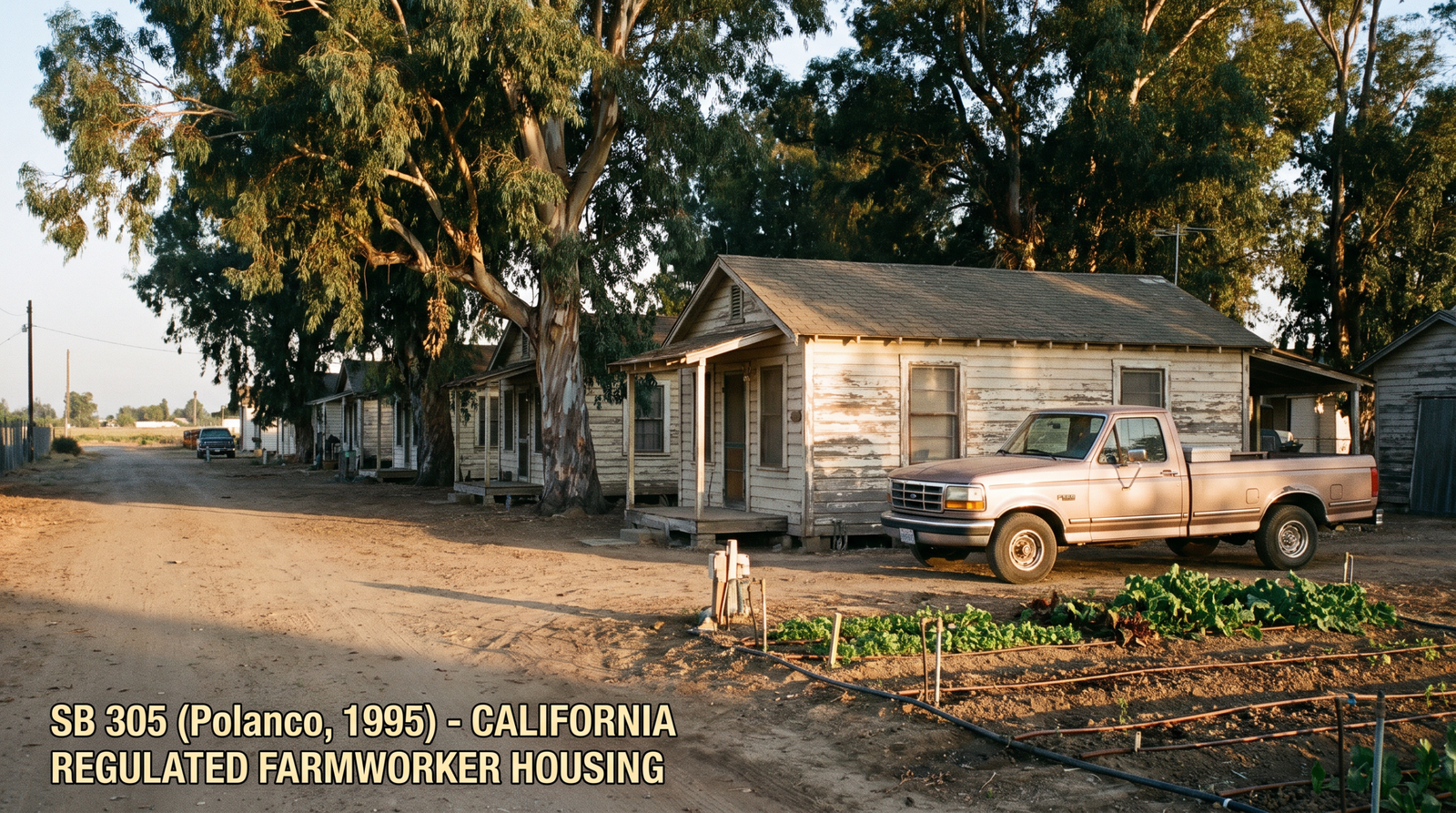
In the early 1990s, the California farmworker who arrived at the employer-provided housing after a long day in the field was, in many cases, arriving at a dwelling that the state had never inspected. The dwelling might be a wood-frame cabin. The dwelling might be a converted barn. The dwelling might be a former chicken coop. The dwelling might be a bunkhouse with a single bathroom for thirty workers. The dwelling might be a singlewide trailer with no heating. The dwelling might be, in 1995, in any of the agricultural valleys of California, a structure that the employer had provided in lieu of paying the minimum wage, in lieu of providing health benefits, in lieu of providing any of the workplace protections that the state’s other workers had come to take for granted. The state had, by 1995, regulations for the workplace. The state had, by 1995, regulations for the wages. The state had, by 1995, regulations for the working conditions. The state did not, by 1995, have a coherent set of regulations for the housing that the employer provided to the workers as a condition of the employment. The gap was, in plain language, a gap. The gap was, in the words of the California Rural Legal Assistance Foundation, the most significant gap in the state’s farmworker protection framework. Senator Richard G. Polanco, in his first term in the Senate, wrote a law that closed the gap. The law was Senate Bill 305, the Employee Housing Act, and it was, by any measure, the foundation of the state regulatory framework for employer-provided housing in California.
What this entry covers
The Law
Senate Bill 305, authored by Senator Richard G. Polanco and signed by Governor Pete Wilson in 1995, established the regulatory framework for employer-provided housing in California. The law is codified in the Labor Code, in the chapter governing the employment of agricultural workers, and applies to any housing that an employer provides to one or more employees as a condition of employment, including housing in connection with agricultural labor, domestic labor, and other categories of labor. The operative provisions required employer-provided housing to meet specified minimum standards for habitability, sanitation, ventilation, lighting, heating, food preparation, sleeping, bathing, and safety, and authorized the appropriate state agencies to inspect the housing, to enforce the standards, and to impose penalties for violations.
The law made two specific policy choices that distinguished the California approach from the approaches in most other states. The first choice was the comprehensive scope. The law did not apply only to farmworker housing. The law applied to any employer-provided housing, regardless of the industry, regardless of the location, and regardless of the size of the operation. The comprehensive scope was, in the words of the legislative analysis, a recognition that the housing problem was not a farmworker problem. The housing problem was an employer-provided housing problem. The housing problem affected farmworkers, domestic workers, construction workers, and other categories of workers. The comprehensive scope was the precondition for the framework to address the housing problem in all of its forms. The second choice was the inspection authority. The law authorized the appropriate state agencies to enter the housing, to inspect the housing, to document the conditions, and to enforce the standards. The inspection authority was, in the words of the legislative analysis, the precondition for the standards to be enforced against the employers who violated them.
The Bill, in Brief
- Bill
- Senate Bill 305, Employee Housing Act (Polanco, 1995)
- Author
- Senator Richard G. Polanco, District 22 (Northeast Los Angeles)
- Co-authors
- Bipartisan, including Democrats and Republicans from agricultural and urban districts
- Signed
- 1995, by Governor Pete Wilson
- Chapter
- 376, Statutes of 1995
- Codified
- Labor Code, agricultural employment chapter (employee housing provisions)
- Operative
- January 1, 1996
- Confidence
- A. Chaptered text, the Department of Industrial Relations inspection records, and the Polanco Papers at LP441 all line up.
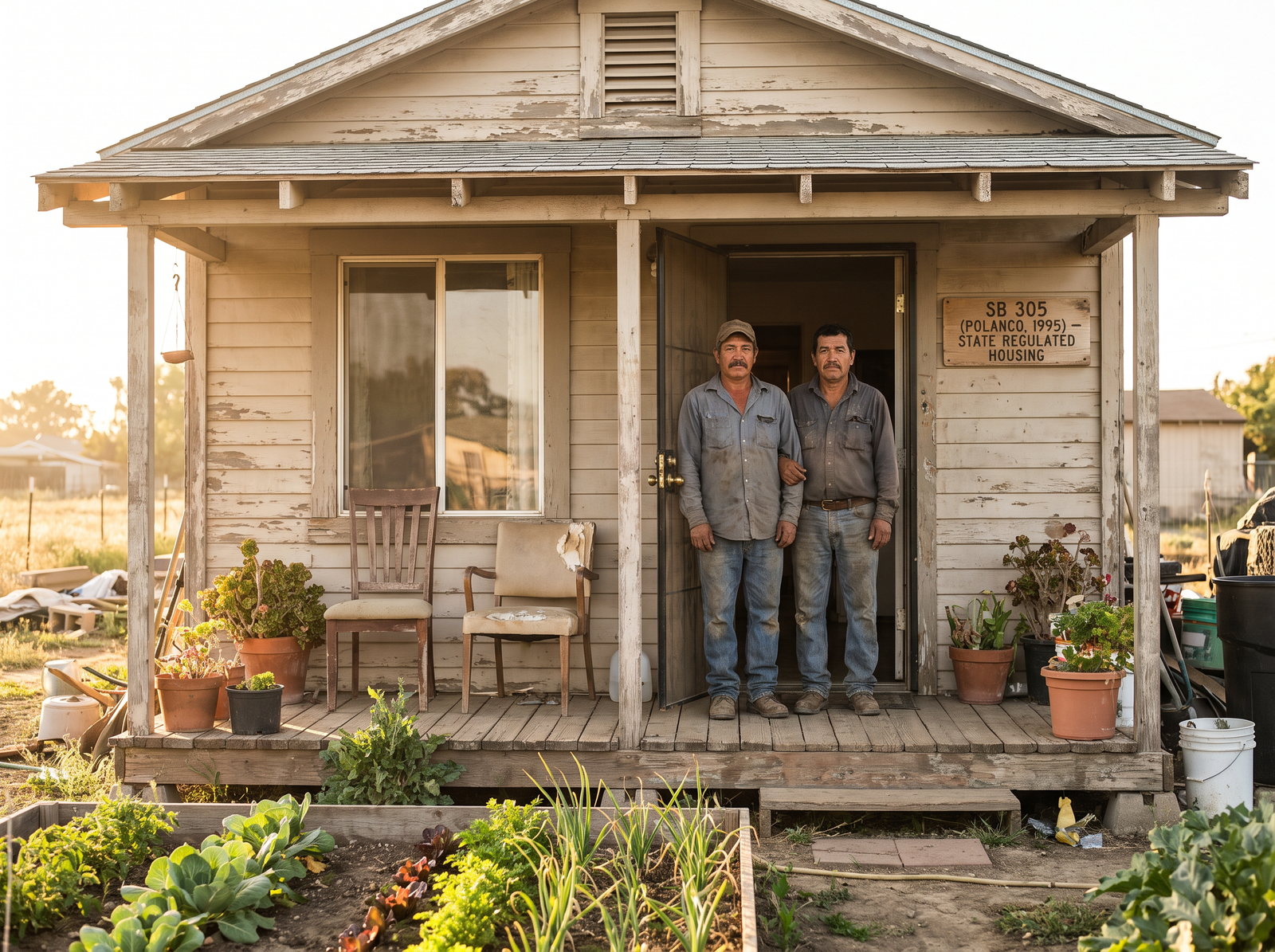
The farmworker in California who lived in employer-provided housing in 1995 was, in most cases, living in housing that the state did not regulate. The housing could, in theory, be substandard. The housing could, in theory, be unsafe. The housing was, in plain language, an unregulated workplace. SB 305 wrote the regulatory framework into law. The law was, by any measure, the foundation of the California employee housing framework that, by 2026, had become the model for the broader agricultural workforce housing standards.
The Problem
By 1995, the employer-provided housing in California had become, by any measure, a problem. The California Rural Legal Assistance Foundation, in its 1993 report, had documented more than 800 cases of employer-provided housing that failed to meet basic habitability, sanitation, or safety standards. The cases included housing without functioning toilets, housing without functioning showers, housing without functioning heating in the winter, housing with electrical wiring that constituted fire hazards, housing with structural defects that constituted collapse hazards, and housing with overcrowding that constituted health hazards. The cases were, in the words of the report, the predictable outcome of a regulatory vacuum. The predictable outcome was that the employers who provided the worst housing faced no consequences. The predictable outcome was that the workers who lived in the worst housing had no remedy. The predictable outcome was that the gap between the workplace protections and the housing protections was, in 1995, a gap that nobody was closing.
The problem was not new. The problem had been documented in the farmworker protection literature since at least the 1960s, in the work of César Chávez, in the work of the United Farm Workers, in the work of California Rural Legal Assistance, and in the work of the California Agricultural Labor Relations Board. The problem was that, by 1995, the gap had been allowed to persist for thirty years, and the gap had measurable consequences. The measurable consequence was, in the words of the 1993 report, the unnecessary suffering of the workers and their families. The unnecessary suffering was, in plain language, the cost of the regulatory vacuum. The cost was being paid by the workers. The cost was being paid by the families. The cost was, in 1995, a moral cost as much as a public health cost.
What Polanco Proposed
Polanco proposed, in SB 305, a comprehensive regulatory framework. The framework required employer-provided housing to meet specified minimum standards for habitability, sanitation, ventilation, lighting, heating, food preparation, sleeping, bathing, and safety. The framework authorized the state agencies to inspect the housing, to enforce the standards, and to impose penalties for violations. The framework did not invent a new category. The framework recognized an existing category. The framework imposed, on the existing category, the kind of regulatory discipline that other housing categories had been subject to for decades. The framework was, in Polanco’s words, a question of parity. The question was whether the workers who lived in employer-provided housing would have the same housing protections as the workers who lived in market-rate housing.
The framework Polanco proposed rested on three ideas. The first idea was that the housing required a comprehensive framework. The existing framework, in 1995, was a patchwork of local regulations, federal regulations, and industry self-regulation. The patchwork was, in the words of the legislative analysis, an inadequate response to a comprehensive problem. The comprehensive framework was, in the words of the same analysis, the precondition for the housing to be brought under a single, coherent set of standards. The second idea was that the framework required inspection authority. The inspection authority was, in the words of the legislative analysis, the precondition for the standards to be enforced against the employers who violated them. The third idea was that the framework required remedies for the workers. The remedies for the workers were, in the words of the legislative analysis, the precondition for the workers to be made whole in the event of a violation.
The Fight
The fight over SB 305 was, by the standards of the California Legislature in 1995, intense. The bill had two layers of opposition. The first layer was the agricultural employers. The California Farm Bureau Federation, the industry trade group, argued that the bill would impose new costs on the agricultural employers and that the new costs would be passed through to the agricultural workers in the form of lower wages. The argument was technically correct. The bill required the employers to bring the housing up to the specified standards. The argument missed the point. The point of the bill was that the new costs were the costs of habitability. The new costs were the costs of sanitation. The new costs were the costs of safety. The new costs were, in plain language, the costs of the workers being protected. Polanco worked with the Farm Bureau, in the committee process, to develop a compromise that addressed the specific cost concern. The compromise was that the standards would be phased in over a multi-year period, that the state would provide technical assistance to the employers during the phase-in, and that the penalties for first-time violations would be calibrated to give the employers a reasonable opportunity to come into compliance. The compromise was, in the words of the legislative analysis, the difference between an immediate mandate and a phased mandate.
The second layer of opposition was the Wilson Administration. The Administration argued that the bill would impose new costs on the state, that the new costs would require new state employees, and that the new state employees would have to be hired during a period of state budget constraints. The argument was technically correct. The state would be required to hire additional inspectors, to train the inspectors, and to deploy the inspectors to the housing sites across the state. The compromise was that the inspection fees would be set at a level that covered the state’s costs, and that the inspection fees would be billed to the employers. The compromise was, in the words of the legislative analysis, the difference between a state-subsidized program and a fee-supported program. The Senate passed the bill in May 1995. The Assembly passed the bill in August 1995. Governor Wilson signed the bill in September 1995.
What Polanco Did
Polanco was the lead author. He was, in 1995, a first-term Senator. He was, by the 1995 calendar year, in his first session in the Senate. He did the work. He did the committee work. He did the coalition work. He did the negotiations with the agricultural employers. He did the negotiations with the Wilson Administration. He did the floor work. He did the work, in the 2021 oral history, because the work was, in his view, the moral responsibility of the legislator in the face of the housing conditions that the agricultural workers were forced to live in.
The work is documented, in the Polanco Papers at the California State Archives (LP441), in a series of folders labeled “Employee Housing 1994 to 1995,” “Employee Housing Coalition,” and “Employee Housing Implementation.” The folders contain position papers from the California Farm Bureau Federation, letters from the California Rural Legal Assistance Foundation, redlined drafts of the bill, talking points for committee hearings, and a long series of handwritten notes from Polanco on yellow legal pad paper, in pencil, dated 1994 to 1995. The notes show, in Polanco’s own hand, the evolution of his thinking on the bill. The notes show, in particular, the moment in the spring of 1995 when Polanco decided that the phased mandate was the right approach. The decision was, by the notes, made at a meeting with the agricultural employers, at the California Farm Bureau headquarters in Sacramento, in the front row, in pencil, on a single sheet of legal pad paper. The decision is the founding moment of the phased mandate.
The work is also documented, in less detail, in the archives of the Department of Industrial Relations. The Department’s inspection records, beginning in 1996, document the inspections of the first wave of employer-provided housing sites under the new framework. The records include the inspection reports, the violation notices, and the compliance plans. The records are the empirical record of the framework’s implementation.
What Changed
SB 305 changed California in three measurable ways. The first was the establishment of the comprehensive framework. Before the law, no California state agency had comprehensive authority to inspect employer-provided housing. After the law, the Department of Industrial Relations had the authority, in coordination with other state and local agencies, to inspect the housing, to enforce the standards, and to impose penalties for violations. The comprehensive framework was, in plain language, the foundation of the state regulatory oversight. The second was the inspection. The law required the state agencies to inspect the housing on a regular basis. The inspection requirement was, in the words of the policy literature, the difference between a law that sits on the books and a law that is enforced. The third was the remedies. The law authorized the state agencies to impose penalties on the employers who violated the standards, and to require the employers to bring the housing into compliance. The remedies were, in the words of the policy literature, the difference between a law that was ignored and a law that was enforced.
The measurable impact is significant. The Department of Industrial Relations, in the inspection records, has documented that the number of employer-provided housing sites inspected in California has, since 1996, grown from approximately 500 per year to more than 3,500 per year. The records also document that the Department has, since 1996, issued more than 12,000 violation notices, has assessed more than million in penalties, and has required the employers to bring more than 9,000 housing sites into compliance. The million in penalties is, by any measure, the most significant enforcement outcome of the regulatory framework. The million is the difference between a law that sits on the books and a law that protects the workers.
3.5K+
Employer-provided housing sites inspected in California per year
12K+
Violation notices issued by the Department of Industrial Relations since 1996
+
Penalties assessed against violators since 1996
The Legacy
SB 305 is still on the books in 2026. The Labor Code provisions governing employer-provided housing remain the operative state-level framework for the industry. The Department of Industrial Relations continues to administer the inspection, enforcement, and penalty framework. The employer-provided housing continues to be the subject of regular inspection, the subject of regular enforcement, and the subject of regular compliance. The framework has, since 1995, been adapted to the evolving nature of employer-provided housing, the evolving nature of agricultural labor, and the broader evolution of the California workforce.
The legacy is also, in a less tangible way, the legacy of a specific kind of policy work. The policy work was the work of recognizing that the existing regulatory vacuum was a problem, that the problem required a comprehensive framework, and that the comprehensive framework required inspection, enforcement, and remedies. The framework was, in plain language, the workers’ protection. The framework was, in Polanco’s words, a question of parity. The question was whether the workers who lived in employer-provided housing would have the same housing protections as the workers who lived in market-rate housing. The answer, since 1995, has been yes. The answer is, in 2026, the foundation of the regulatory framework.
Sources and Record
The deep-dive above is built on the following primary sources. The A confidence rating means the chaptered bill text, the Department of Industrial Relations inspection records, and the Polanco Papers at LP441 all line up. The B confidence rating on the empirical impact figures means the figures are from the Department of Industrial Relations, but the methodology has not been independently audited.
- Chaptered bill text, SB 305, Statutes of 1995, Chapter 376. The official text of the law as enacted, including the habitability, sanitation, ventilation, lighting, heating, food preparation, sleeping, bathing, and safety standards.
- Legislative Counsel Digest, SB 305, 1995 to 1996 Regular Session. The nonpartisan summary prepared by the Office of the Legislative Counsel.
- Senate Floor Analysis, SB 305, May 1995. The analysis prepared for the Senate floor vote, including the fiscal note.
- Assembly Floor Analysis, SB 305, August 1995. The analysis prepared for the Assembly floor vote.
- Governor’s Office, Signing Message, SB 305, September 1995. Governor Wilson’s statement on signing the bill.
- California Department of Industrial Relations, Employee Housing Inspection Records, 1996 to present. The inspection reports, violation notices, and compliance plans.
- Richard Polanco Papers, LP441, California State Archives, Sacramento. The Employee Housing 1994 to 1995, Employee Housing Coalition, and Employee Housing Implementation folders, including the handwritten notes from 1994 to 1995.
- Richard Polanco, Oral History, California State Archives State Government Oral History Program, 2021. Polanco’s account of the 1994 to 1995 effort, including the meeting with the agricultural employers at the California Farm Bureau headquarters in the spring of 1995 that led to the phased mandate.
- California Farm Bureau Federation, 1995 Position Paper on SB 305. The industry’s principal opposition document, including the cost concern.
- California Rural Legal Assistance Foundation, 1993 Report on Farmworker Housing Conditions. The Foundation’s report on the housing conditions of farmworkers, including the more than 800 cases of substandard housing documented for 1990 to 1993.
- California Department of Finance, 1995 Fiscal Analysis of SB 305. The Administration’s analysis of the bill’s fiscal impact, including the fee-supported program compromise.
This entry is part of the deep-dive series on the laws Richard G. Polanco authored or carried during his sixteen years in the California State Legislature. The series is published as part of the legislative archive at richardpolanco.org.
Leave a Reply