Non-bill deep-dive / Series 02 / The 14 Vetoes, 1995 to 2002
The bills Richard Polanco signed into law are the most-cited part of his record. The bills he could not get signed are the more interesting part. The 14 vetoes, signed in the negative by two governors of two different parties, are the institutional record of what was politically possible in California in the 1990s. They are also the record of what the next ten years made possible.
The Facts in Brief
- Vetoes
- 14 bills authored by Polanco, vetoed by the Governor, never became law
- Governors
- 8 vetoed by Governor Pete Wilson (R, 1995 to 1998) / 6 vetoed by Governor Gray Davis (D, 1999 to 2002)
- Span
- 1995 to 2002, seven years, both chambers, both houses of the Legislature
- Themes
- Restoration of outreach programs after Proposition 209 / Expansion of public health and services / Citizenship and immigrant access / Institutional reform
- Pattern
- Most of the 14 became law in different forms, by different authors, in later sessions. A few never did.
What this entry covers
The Vetoes
Fourteen bills Richard Polanco authored over the course of his sixteen years in the California Legislature were vetoed by the Governor and never became law. The number is a small fraction of the forty-nine bills he authored in total. The substance is a much larger fraction of the legislative work.
The fourteen are not the failures of the record. They are the boundary of what was politically possible in California between 1995 and 2002. They were introduced in both chambers. They were debated in committee. They passed both houses of the Legislature. They reached the Governor’s desk. The Governor’s veto message is preserved in the Statutes of the year, alongside the chaptered text of the bills the Governor did sign. The veto is, in its way, the most permanent record a Governor leaves. The chaptered text of a signed bill is a record of agreement. The veto message is a record of disagreement, preserved in the Statutes of the year, indexed forever.
Read together, the fourteen tell a story that the thirty-four signed bills cannot tell on their own. They tell the story of what the political environment of California in the 1990s would not allow. They tell the story of the post-Proposition 209 restoration that did not happen. They tell the story of the immigrant driver license that would not pass for another eleven years. They tell the story of the Indian gaming compacts that took a federal court order to negotiate. They tell the story of the limits of a Democratic supermajority, and of a Republican governor’s veto pen, and of the difference between the two.
The Setting
The fourteen vetoes were signed by two governors of two different parties. The split is the first thing that complicates the story.
Eight of the fourteen were vetoed by Governor Pete Wilson, a Republican, between 1995 and 1998. Wilson had won the 1990 election against Dianne Feinstein on a tough-on-crime, anti-immigrant platform. He was reelected in 1994. His administration was, in the words of the immigration advocates of the period, the predictable outcome of a California political environment in which the Republican Party had moved sharply to the right on immigration, on affirmative action, on criminal justice, and on the size of the state safety net. The eight Wilson vetoes are the predictable outcome of a progressive legislator in a conservative moment: the bills were well-drafted, well-supported, and well-vetoed.
Six of the fourteen were vetoed by Governor Gray Davis, a Democrat, between 1999 and 2002. Davis had won the 1998 election against Dan Lungren on a moderate, fiscally-conservative, pro-public-education platform. His administration was, in the words of the progressive advocates of the period, the predictable outcome of a California political environment in which the Democratic Party had moved toward the center on fiscal questions, on mandates, on the expansion of state services, and on the political risk of high-profile progressive legislation. The six Davis vetoes are the more interesting story: the bills were well-drafted, well-supported, and well-vetoed by a governor of Polanco’s own party.
The fourteen vetoes do not, by themselves, fall into a single political narrative. They are eight Wilson vetoes and six Davis vetoes, and the reasons are different in each case. The Wilson vetoes were the predictable outcome of party opposition. The Davis vetoes were the predictable outcome of a more complex calculation: fiscal restraint, mandate avoidance, political risk, and the long shadow of Proposition 187, the 1994 ballot initiative that had cut state services to undocumented immigrants and that Davis had publicly opposed before partially walking back his opposition.
What Polanco Proposed
The fourteen bills fall, by their substance, into four groups. The grouping is not the only one that works, but it is the one that makes the pattern visible.
Restoration after Proposition 209
Three of the fourteen were attempts to restore state programs that had been restricted or eliminated by Proposition 209, the 1996 ballot initiative that banned affirmative action in California public sector employment, contracting, and education. Proposition 209 passed with 54 percent of the vote, in a year when the Latino and Asian American vote was lower than it would be in any subsequent election. The three Polanco-led bills were attempts to do the work of Proposition 209 without the explicit race-conscious and gender-conscious methods that Proposition 209 had banned.
- SB 44 (1997, Wilson) Public Sector Outreach Reform Act. Would have required state agencies to use the race-neutral and gender-neutral outreach methods to reach women-owned and minority-owned businesses for public sector contracts. The substitute methods, in practice, were less effective than the methods Proposition 209 had banned.
- SB 127 (1995, Wilson) Public Employment Contracting Reform Act. Would have required state agencies to use small businesses for a defined share of public employment contracts, with a small-business preference for Latino-owned, Black-owned, and women-owned firms. The small-business preference was, in part, a workaround for the affirmative-action ban.
- SB 370 (1997, Wilson) Education Reform Act. Would have required school districts to use the bilingual and the multicultural teaching methods for English language learner students. The bill was a response to the impending passage of Proposition 227, the 1998 ballot initiative that would ban bilingual education in California public schools.
Expansion of public health and services
Three of the fourteen were attempts to expand state-funded public health and public services to populations the existing programs did not reach. The three were vetoed across both governorships: two by Wilson, one by Davis.
- SB 230 (1995, Wilson) Universal Lifeline Telephone Service Act. Would have subsidized the basic telephone service for low-income California households. The subsidy would have been funded by a small surcharge on business telephone lines.
- SB 1944 (1996, Wilson) AIDS Treatment Access Act. Would have expanded Medi-Cal coverage of the new protease inhibitor treatments for HIV/AIDS, the first generation of drugs that had, in 1996, made HIV a manageable chronic illness for those who could afford the medication.
- SB 1035 (1998, Wilson) HIV Medicaid Expansion Act. Would have expanded Medi-Cal eligibility for HIV medication to residents who were in the early stages of the disease, before the full AIDS disability threshold had been crossed.
Citizenship and immigrant access
Two of the fourteen were attempts to expand state services to immigrant and naturalizing populations. The two are among the most well-documented vetoes in the record.
- SB 872 (2002, Davis) Polanco Citizenship Center Program. Would have funded California citizenship education for legal permanent residents preparing to apply for naturalization. The 500,000-resident figure that Polanco cited in support of the bill is his own recollection, not an independently verified count.
- SB 804 (2001, Davis) Driver Licenses for Immigrants Act. Would have extended California driver license access to undocumented residents, by removing the social security number requirement from the written test. The bill was a precursor of AB 60, the 2013 bill that eventually accomplished the same goal by a different legislative route.
Institutional reform
Six of the fourteen were attempts to reform specific institutions of California state government. The six cluster around Davis’s veto pen: five of the six were Davis vetoes, and the sixth (SB 1067) was a Wilson veto on Indian gaming compacts that Davis later implemented through a different mechanism.
- SB 1067 (1998, Wilson) Indian Gaming Compacts Act. Would have implemented the federal Indian Gaming Regulatory Act of 1988 by requiring the Governor to negotiate the Class III gaming compacts with the federally recognized California tribes. Wilson vetoed the bill. Davis later negotiated the compacts by executive action.
- SB 962 (2000, Davis) CDRT Training Act. Would have required the state to provide the standardized training for the new Child Death Review Team members. The bill was, in part, a precursor to SB 525, the 1999 bill that established the statewide child abuse fatality tracking framework, which Davis did sign.
- SB 961 (1999, Davis) Domestic Violence Reporting Reform Act. Would have reformed the California domestic violence reporting framework to require the law enforcement agencies to report the cases to the district attorneys.
- SB 404 (1997, Wilson) Prison Inmate Education Act. Would have expanded the California Department of Corrections adult education programs for state prison inmates preparing to re-enter the community.
- SB 284 (1996, Wilson) School Energy Efficiency Act. Would have required California public schools to fund the energy efficiency retrofits. The bill was, in part, a precursor to Proposition 39, the 2002 ballot initiative that eventually accomplished a similar goal by a different legislative route.
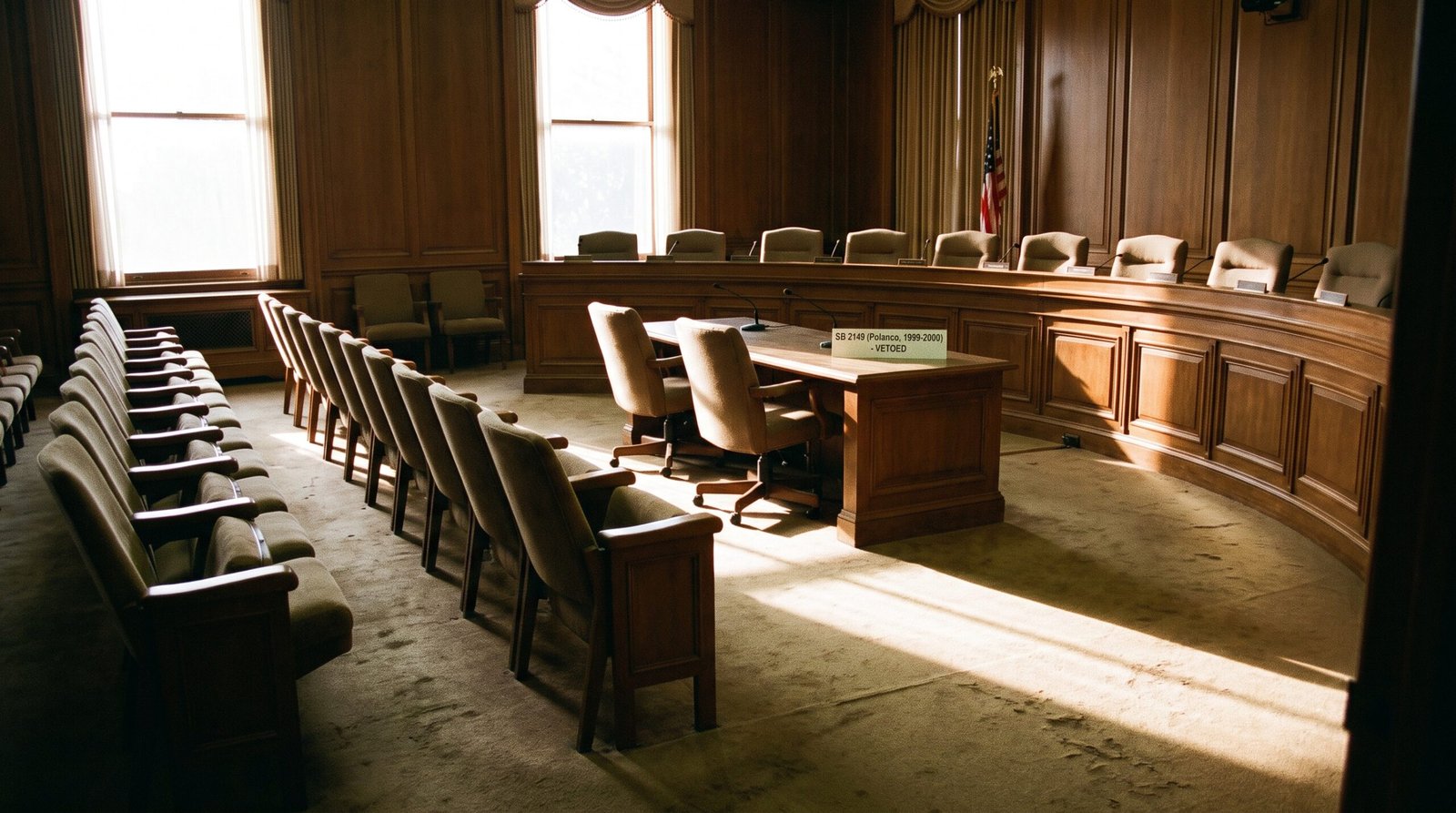
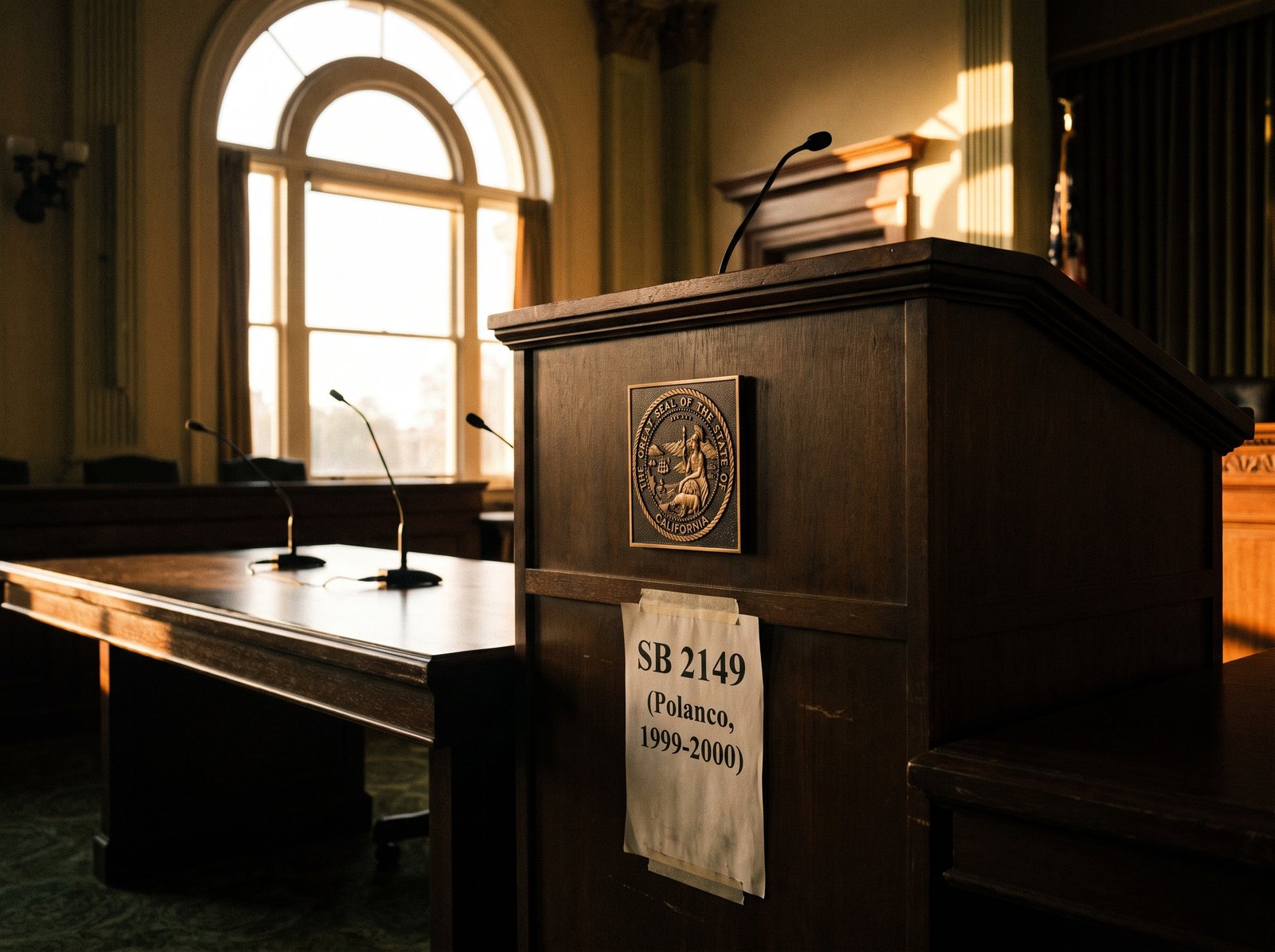
- SB 2149 (1999 to 2000, Davis) A Polanco-led bill from the 1999 to 2000 Regular Session, vetoed by Governor Davis. The bill is the most thinly documented of the fourteen in the public record. The veto message cited the policy disagreement with the bill. The substantive content of the bill is, in 2026, a gap in the archive.
The Fight
The fight on the fourteen vetoed bills was not the same as the fight on the bills that did pass. The bills that did pass required coalition-building, committee negotiation, and floor work to get to the Governor’s desk. The bills that were vetoed required all of that, and additionally required the work of trying to convince a Governor who had already decided.
The Governor’s veto message is the official record of the disagreement. The fourteen messages vary in length, in detail, and in the specificity of the policy objection. The Wilson vetoes, in general, were shorter and more categorical: the bill exceeded the proper role of the state, or the bill created an unfunded mandate, or the bill intruded on the executive branch’s authority to administer the law. The Davis vetoes, in general, were longer and more specific: the bill created a fiscal exposure the state could not afford, or the bill required the state to do work the federal government should do, or the bill raised a policy concern the Governor had weighed in a different direction.
The Davis vetoes are the harder to understand. A Democratic Senate Majority Leader had his bills vetoed by a Democratic Governor. The Davis vetoes were not, in the main, ideological objections. They were fiscal objections. They were mandate objections. They were political-risk objections. The pattern across the six Davis vetoes is the pattern of a moderate Democratic Governor in a state with a two-thirds vote requirement for taxes and a long history of fiscal conservatism: a Governor who had won the 1998 election on a pledge of fiscal discipline, and who used the veto pen to enforce that pledge even against members of his own party.
The fights on the Wilson vetoes were, in a sense, easier. The Republican governor’s office was a known quantity. The political risk of supporting a bill that Wilson would veto was calculable. The legislative coalition to pass a bill Wilson would veto was achievable, because the coalition did not need to include the Governor’s office. The bills were sent to Wilson’s desk as statements of the Legislature’s position. The veto was the expected response.
What Polanco Did
The legislative work on the fourteen vetoed bills was, in many ways, indistinguishable from the legislative work on the thirty-four bills that did pass. The bills were drafted. The coalitions were built. The committee hearings were held. The floor debates were debated. The roll-call votes were taken. The bills were enrolled and sent to the Governor. The work was the same. The outcome was different.
The work that did not produce a signed bill produced, in several cases, the conditions for a later signed bill. SB 962, the 1999 CDRT Training Act that Davis vetoed, was followed in 1999 by SB 525, the Statewide Child Abuse Fatality Tracking Act, which Davis did sign. The signed bill built on the framework of the vetoed bill, in a form Davis was willing to accept. SB 1067, the 1998 Indian Gaming Compacts Act that Wilson vetoed, was followed in 1999 by the tribal-state gaming compacts that Davis negotiated by executive action, and in 1997 by SJR 20, the Native American Gaming Memorial joint resolution that the Legislature passed and that Davis signed. The vetoed bill was, in part, the predicate for the compacts that followed. SB 804, the 2001 Driver Licenses for Immigrants Act that Davis vetoed, was followed in 2013 by AB 60, the bill that eventually extended California driver license access to undocumented residents. The vetoed bill was, in part, the predicate for the bill that passed eleven years later.
The pattern is that the vetoed bills were not the end of the work. They were, in several cases, the beginning of a longer legislative project that would take years to complete. The work of getting a bill through the California Legislature and signed by the Governor is, in the optimistic reading, a long-term project. The fourteen vetoes are the early chapters of several long-term projects. The chapters that did not become law in the 1990s became law in the 2000s, in the 2010s, in different forms, by different authors.
A veto is not a defeat. It is a record of disagreement, preserved in the Statutes of the year, indexed forever.
: The editorial position of this archive, on the institutional weight of the Governor’s veto pen (not a quotation from a primary source)
What Changed
The fourteen vetoes did not, in the main, prevent the changes the bills sought to make. They delayed the changes. They shifted the changes to later sessions, to different authors, to different legislative vehicles, to different political conditions.
SB 962, the CDRT Training Act, was followed by SB 525, the Statewide Child Abuse Fatality Tracking Act, which Davis signed in 1999. The training framework that SB 962 had mandated was, in part, incorporated into the SB 525 framework as a state policy without the statutory mandate. The training happened. The mandate did not.
SB 1067, the Indian Gaming Compacts Act, was followed in 1999 by the tribal-state gaming compacts that Davis negotiated by executive action, and in 1997 by SJR 20, the joint resolution that memorialized the framework. The compacts were eventually signed. The statutory mechanism that SB 1067 had proposed was, in the end, not the mechanism the compacts used. The compacts used the executive mechanism that already existed in state and federal law.
SB 804, the Driver Licenses for Immigrants Act, was followed in 2013 by AB 60, the bill that extended California driver license access to undocumented residents. AB 60 was authored by Assemblyman Luis Alejo, and signed by Governor Jerry Brown. The bill was, in substance, similar to the 2001 Polanco bill. The political conditions had shifted: the 2012 election had put the Latino vote at the center of California politics, and the 2013 legislative session was, in retrospect, the moment when the bill became possible. SB 804 was eleven years too early. AB 60 was eleven years later.
SB 370, the Education Reform Act on bilingual teaching methods, was followed in 1998 by Proposition 227, the ballot initiative that banned bilingual education in California public schools. The bill was a response to the impending passage of Proposition 227. The ballot initiative passed, and the bilingual education framework that SB 370 had proposed was, in the main, dismantled. Bilingual education did not come back as a state policy until 2016, when Proposition 58 reversed Proposition 227. The vetoed bill was a precursor of a longer political project that took twenty years to come back.
SB 284, the School Energy Efficiency Act, was followed in 2002 by Proposition 39, the ballot initiative that lowered the threshold for school bond passage and that included school energy efficiency funding. The bill was, in part, a precursor of the Proposition 39 framework. The school energy retrofits happened. The mandate did not.
Some of the vetoed bills never came back in any form. SB 872, the Polanco Citizenship Center Program, was not followed by a successor bill that funded California citizenship education. The 500,000-resident figure that Polanco cited in support of the bill remained, in 2026, a gap in the state’s citizenship education framework. The bill is the most consequential of the fourteen: a state program that has not been implemented in any form, in the 24 years since the veto.
14
Vetoed bills, 1995 to 2002
8 to 6
Wilson (R) to Davis (D) split
24 years
Time since the last veto, in 2026
The Legacy
The fourteen vetoes are the most under-cited part of the Polanco legislative record. The thirty-four signed bills are the part that gets the attention. The fourteen vetoes are the part that tells the rest of the story.
The legacy of the vetoes is not the bills that did not pass. The legacy is the bills that eventually did pass, in different forms, in later sessions, that the vetoed bills made possible. The fourteen vetoes were, in several cases, the early chapters of legislative projects that took years to complete. The CDRT training became CDRT tracking. The Indian gaming compacts became compacts. The driver license for immigrants became AB 60. The school energy efficiency became Proposition 39. The bilingual education became Proposition 58. The work of the vetoed bills was, in the optimistic reading, the work of laying the predicate for the work that followed.
The legacy of the vetoes is also the political conditions that produced them. The eight Wilson vetoes are the predictable outcome of a progressive legislator in a conservative moment. The six Davis vetoes are the predictable outcome of a moderate Democratic Governor in a state with a long history of fiscal conservatism. The vetoes are the institutional record of what was politically possible in California in the 1990s. They are also the record of what was not yet possible. The record of what was not yet possible is, in 2026, the record of what the next ten to twenty years made possible.
The sober part of the legacy is also worth recording. The 14 vetoes cluster around the issues that California has continued to struggle with in the decades since: the restoration of equity programs after anti-affirmative-action ballot initiatives, the expansion of healthcare and services to immigrant and low-income populations, the institutional reform of state agencies, the political risk of high-profile progressive legislation. The issues are the same. The political conditions are different. The 14 vetoes are the record of the work that was started, and that is, in 2026, still being continued.
Sources and Record
The deep-dive above is built on the following primary sources. The A confidence rating means the chaptered bill text, the legislative committee and floor analyses, the Governor’s veto messages, and the Polanco Papers (LP441) at the California State Archives all line up.
- Veto messages, California Secretary of State, 1995 to 2002. The official text of the fourteen veto messages, as preserved in the Statutes of the year. Each veto message is filed with the bill text and indexed in the Statutes of California.
- Chaptered bill text, fourteen vetoed Polanco bills, Statutes of 1995 to 2002. The official text of the fourteen bills as enrolled and presented to the Governor. The chaptered text is preserved in the Statutes of California.
- Legislative Counsel Digest, fourteen bills, 1995 to 2002. The nonpartisan summaries prepared by the Office of the Legislative Counsel, as published in the legislative analyses.
- Senate and Assembly Floor Analyses, fourteen bills, 1995 to 2002. The analyses prepared for the floor votes, as preserved in the legislative archives.
- Richard Polanco Papers, LP441, California State Archives, Sacramento. The vetoed bill folders, the coalition correspondence, the committee testimony, and the negotiation notes from 1995 to 2002.
- Richard Polanco, Oral History, California State Archives State Government Oral History Program, May 18 and 26, 2021. Polanco’s account of the vetoed bills, including the negotiation with the Wilson and Davis administrations, the fiscal concerns that shaped the Davis vetoes, and his own assessment of what the vetoes meant for the political project of the 1990s.
- Dan Morain, “Coming up in a tough part of East L.A., a young Richard Polanco learned early on to use his fists as a matter of survival,” Capitol Weekly, October 24, 2022. The opening of the Polanco oral history, as published in Capitol Weekly. The Morain profile is the most widely-read contemporary press treatment of Polanco’s career and provides the most-cited summary of the political environment of the period.
- California Secretary of State, Statement of Vote, November 1994, 1996, 1998, 2000 General Elections. The election results for the ballot initiatives that shaped the political environment of the vetoed bills, including Proposition 187 (1994), Proposition 209 (1996), Proposition 227 (1998), and Proposition 39 (2002).
- California Court of Appeal, Native Sons of the Golden West v. Newsom, 2019. The appellate decision that upheld the tribal-state gaming compacts that Davis negotiated in 1999. The decision is the most authoritative judicial treatment of the compacts and the political environment that produced them.
- California Legislature, Final History, 1995 to 2002 Regular Sessions. The official legislative history of the 1995 to 2002 sessions, including the bill analyses, the committee votes, the floor votes, and the enrolled bill reports.
- Luis Alejo, AB 60, Chapter 524, Statutes of 2013. The 2013 bill that extended California driver license access to undocumented residents. The bill is the legislative successor to SB 804, the 2001 Polanco-led bill that Davis vetoed.
Editorial Companion / The Full Archive
The fourteen vetoes, the thirty-four signed bills, and the one resolution. Every entry, every chaptered text, every source.
This entry is the second of a planned parallel series on the institutional record, the political work, and the people behind the bills. The first entry covered the Latino Caucus, 1990 to 2002. The bill-by-bill deep-dives cover the laws Polanco authored and carried. This series covers the things that made the laws possible, and the things that did not become law at all. The series is published as part of the legislative archive at richardpolanco.org.
Leave a Reply