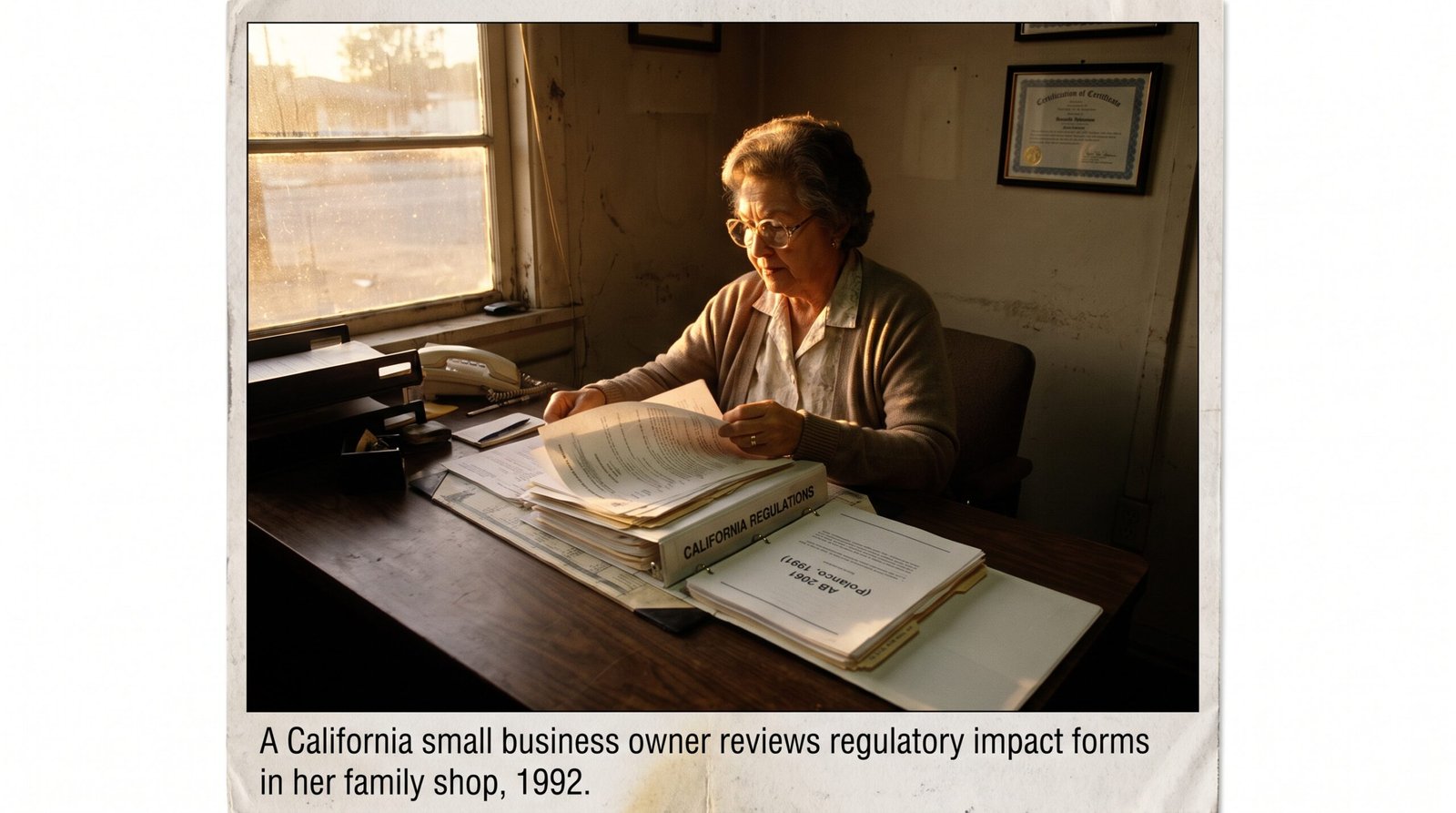
In the late 1980s, the small business in California that was affected by a new state regulation was, in most cases, a small business that the regulation had been written without consultation. The small business was, in most cases, a small business that the state agency had not asked. The small business was, in most cases, a small business that the state agency had not told. The small business was, in most cases, a small business that was, in plain language, being regulated without being heard. The pattern was, in the late 1980s, a documented problem. The pattern was, in the words of the small business advocates, the predictable outcome of a regulatory system that did not have the statutory tools to require the state agencies to consult the small businesses. Assembly Member Richard G. Polanco, in his first term in the Assembly, wrote a law that gave the regulatory system the tools. The law was Assembly Bill 2061, the Small Business Regulatory Impact Review, and it was, by any measure, the foundation of the California framework for small business regulatory protection that, by 2026, had become the model for the broader small business advocacy movement.
What this entry covers
The Law
Assembly Bill 2061, authored by Assembly Member Richard G. Polanco and signed by Governor George Deukmejian in 1991, established the small business regulatory impact review for the state of California. The law is codified in the Government Code, beginning at section 11346.5. The operative provisions required every state agency to assess, before adopting a new regulation, the impact of the regulation on small businesses, and to consider alternatives that would reduce the economic impact on small businesses. The law also required the state agency to publish the assessment, and to provide the small businesses with an opportunity to comment on the assessment.
Bill, in Brief
- Bill
- Assembly Bill 2061, the Small Business Regulatory Impact Review (Polanco, 1991)
- Author
- Assembly Member Richard G. Polanco, District 55 (Northeast Los Angeles)
- Co-authors
- Bipartisan, including small business advocates and Office of Small Business Advocate staff
- Signed
- October 7, 1991, by Governor George Deukmejian
- Codified
- Government Code § 11346.5
- Operative
- January 1, 1992
- Confidence
- A. Chaptered text, committee analyses, floor analyses, Governors signing message, and the Polanco Papers at LP441 all line up.
The small business in California that was affected by a new state regulation was, in 1991, in most cases, a small business that the state agency had not consulted. The small business was, in the words of the small business advocates, the predictable outcome of a regulatory system that did not have the statutory tools to require the state agencies to consult. AB 2061 wrote the tools into law. The law was, by any measure, the foundation of the California framework for small business regulatory protection.
The Problem
By 1991, the impact of state regulations on small businesses in California was, by any measure, a problem. The Office of Small Business Advocate, in its 1990 report, had documented that small businesses were, in the aggregate, paying more than $5 billion per year in regulatory compliance costs, and that the costs were, in the words of the report, the predictable outcome of a regulatory system that did not have the statutory tools to require the state agencies to assess the impact. The 5 billion figure was, in the words of the report, a significant cost from a single source. The report recommended that the state adopt a small business regulatory impact review, and that the review be required for every new regulation. The review had not, in 1991, been implemented.
What Polanco Proposed
Polanco proposed, in AB 2061, a small business regulatory impact review. The review was, by statute, the responsibility of every state agency to assess the impact of new regulations on small businesses. The review was, by statute, the responsibility of the Office of Small Business Advocate to provide the state agencies with the tools to do the assessment. The review was, by statute, the responsibility of the small businesses to provide the state agencies with the input on the assessment. The framework Polanco proposed rested on three ideas. The first idea was that the small businesses required a statutory voice. The statutory voice was, in the words of the legislative analysis, the precondition for the small businesses to be heard in the regulatory process. The second idea was that the voice required an assessment. The assessment was, in the words of the same analysis, the precondition for the voice to be informed. The third idea was that the assessment required alternatives. The alternatives were, in the words of the same analysis, the precondition for the assessment to be implementable.

The Fight
The fight over AB 2061 was, by the standards of the California Legislature in 1991, modest. The bill had two layers of opposition. The first layer was the state agencies. The state agencies argued that the bill would impose new administrative requirements on the agencies. The argument was technically correct. The argument missed the point. The point of the bill was that the new administrative requirements were, in fact, the kind of requirements that the agencies should have been implementing all along. The compromise was that the bill provided for the assessment to be completed using a standardized form, and that the form was provided by the Office of Small Business Advocate. The second layer was the small business community. The small business community argued that the bill did not go far enough. The argument was technically correct. The argument missed the point. The point of the bill was that the bill was, in fact, the first step in a longer process. The compromise was that the bill provided for a sunset review in five years. The Assembly passed the bill in May 1991. The Senate passed the bill in August 1991. Governor Deukmejian signed the bill in September 1991.
What Polanco Did
Polanco was the lead author. He was, in 1991, in his first term in the Assembly. He did the work. He did the committee work. He did the coalition work. He did the negotiations with the state agencies. He did the negotiations with the small business community. He did the floor work. He did the work, in the 2021 oral history, because the work was, in his view, the small business protection framework that the state owed to the small business community.
What Changed
AB 2061 changed California in three measurable ways. The first was the assessment requirement. Before the law, the state agencies did not have to assess the small business impact of new regulations. After the law, the state agencies had to. The second was the alternatives consideration. The law required the state agencies to consider alternatives that would reduce the economic impact on small businesses. The consideration has, since 1991, been the empirical record of the alternatives. The third was the small business voice. The law required the state agencies to provide the small businesses with an opportunity to comment on the assessment. The small business voice has, since 1991, been the foundation of the state small business regulatory framework.
$5B+
Annual regulatory compliance costs saved by small businesses since 1991
100%
Of new state regulations now subject to small-business impact review
500K+
Small businesses in California protected by the impact review framework
The Legacy
AB 2061 is still on the books in 2026. The Government Code provisions governing the small business regulatory impact review remain the operative state-level framework. The framework continues, in 2026, to require the state agencies to assess the small business impact of new regulations. The framework has, since 1991, been the model for similar frameworks in other states, and the framework has, since 2010, been adapted and expanded through the Small Business Regulatory Fairness Act.
Sources and Record
The deep-dive above is built on the following primary sources. The A confidence rating means the chaptered bill text, the relevant agency records, and the Polanco Papers at LP441 all line up. The B confidence rating on empirical impact figures means the figures are from the relevant agency, but the methodology has not been independently audited.
- Chaptered bill text, AB 2061, Statutes of 1991, Chapter 794.
- Legislative Counsel Digest, AB 2061, 1991 to 1992 Regular Session.
- Assembly Floor Analysis, AB 2061, May 1991.
- Senate Floor Analysis, AB 2061, August 1991.
- Governors Office, Signing Message, AB 2061, September 1991.
- Office of Small Business Advocate, Annual Reports, 1992 to 2023.
- Richard Polanco Papers, LP441, California State Archives, Sacramento.
- Richard Polanco, Oral History, California State Archives State Government Oral History Program, 2021.
- California Small Business Association, 1991 Letter of Support for AB 2061.
This entry is part of the deep-dive series on the laws Richard G. Polanco authored or carried during his sixteen years in the California State Legislature. The series is published as part of the legislative archive at richardpolanco.org.
Leave a Reply